


This is a proposed strategy for the Lawrenceville School to generate and nurture relationships with prospective families. It proposes a much longer customer cycle and content production that will strengthen the brand and Lawrenceville’s place in the market and as a thought leader in education.
When do our families’ journeys begin? When does their journey with LAWRENCEVILLE begin?
Are we entering at a time when families will need a lot of information and persuasion in order to choose Lawrenceville?
What if we could be there with them the whole way? What if we could feel more certain that our applicants will be a good fit for the school and that our admitted students will choose us in the end?
We can form longer, stronger connections with prospective families.

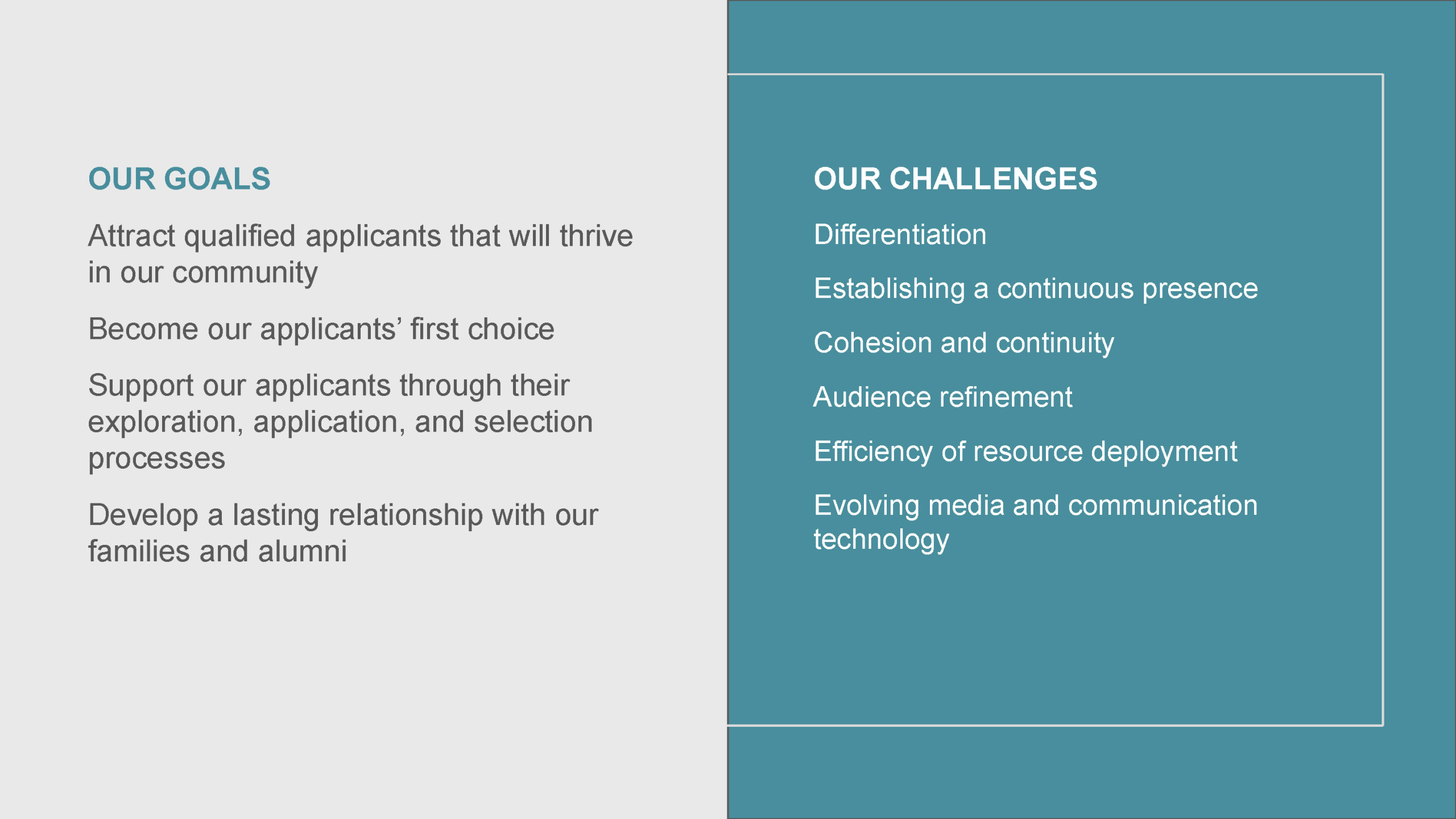
We already have some operational goals that we work toward every day. These goals come with challenges, which we do work to address, but there are opportunities to strategically lean into solutions that will shift effort to automated processes over a longer period of time. Instead of trying to attract, nurture, and yield a family within the span of one year, we can start sooner and in a more measured, lasting way.
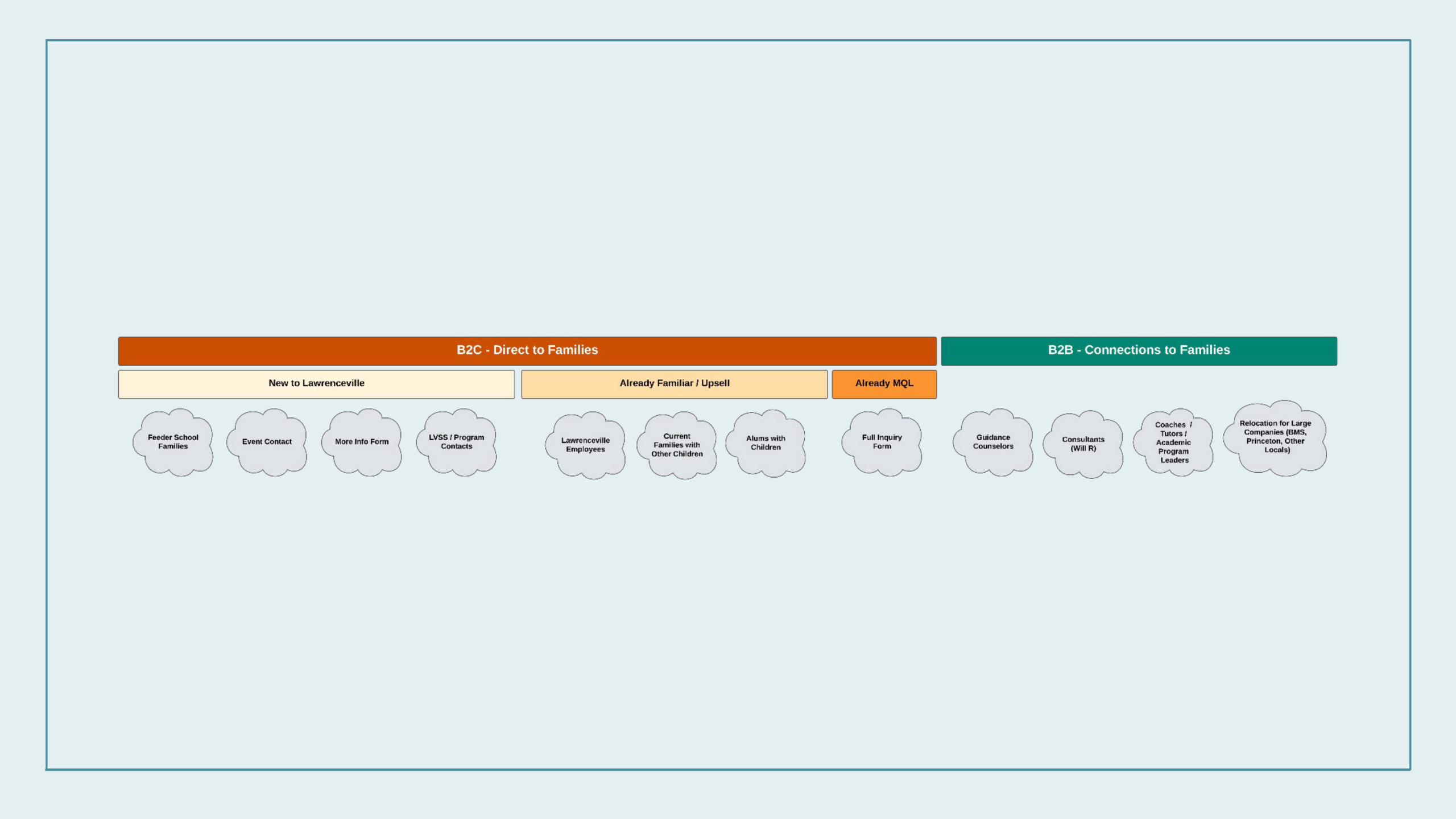
One way to address our challenges is to break down our audiences into smaller groups. Mainly, we speak directly to families, and have not yet explored a B2B angle to our communications.
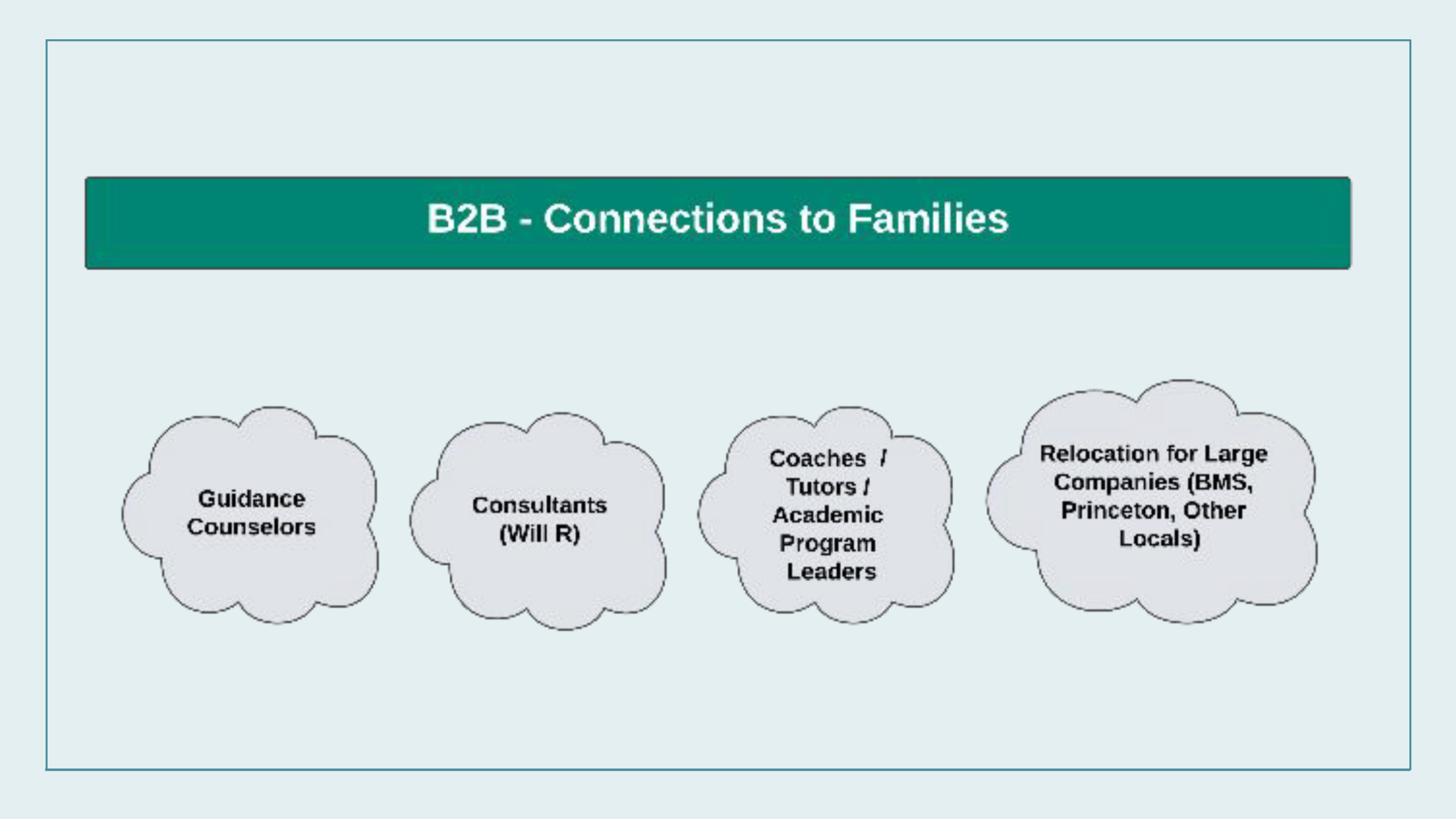
There is room to grow our group of prospective families by approaching new audiences like counselors, consultants, and other people who facilitate decision making for parents. This is a completely new audience for us, and may prove to be a utility for expanding and refining our family audience.
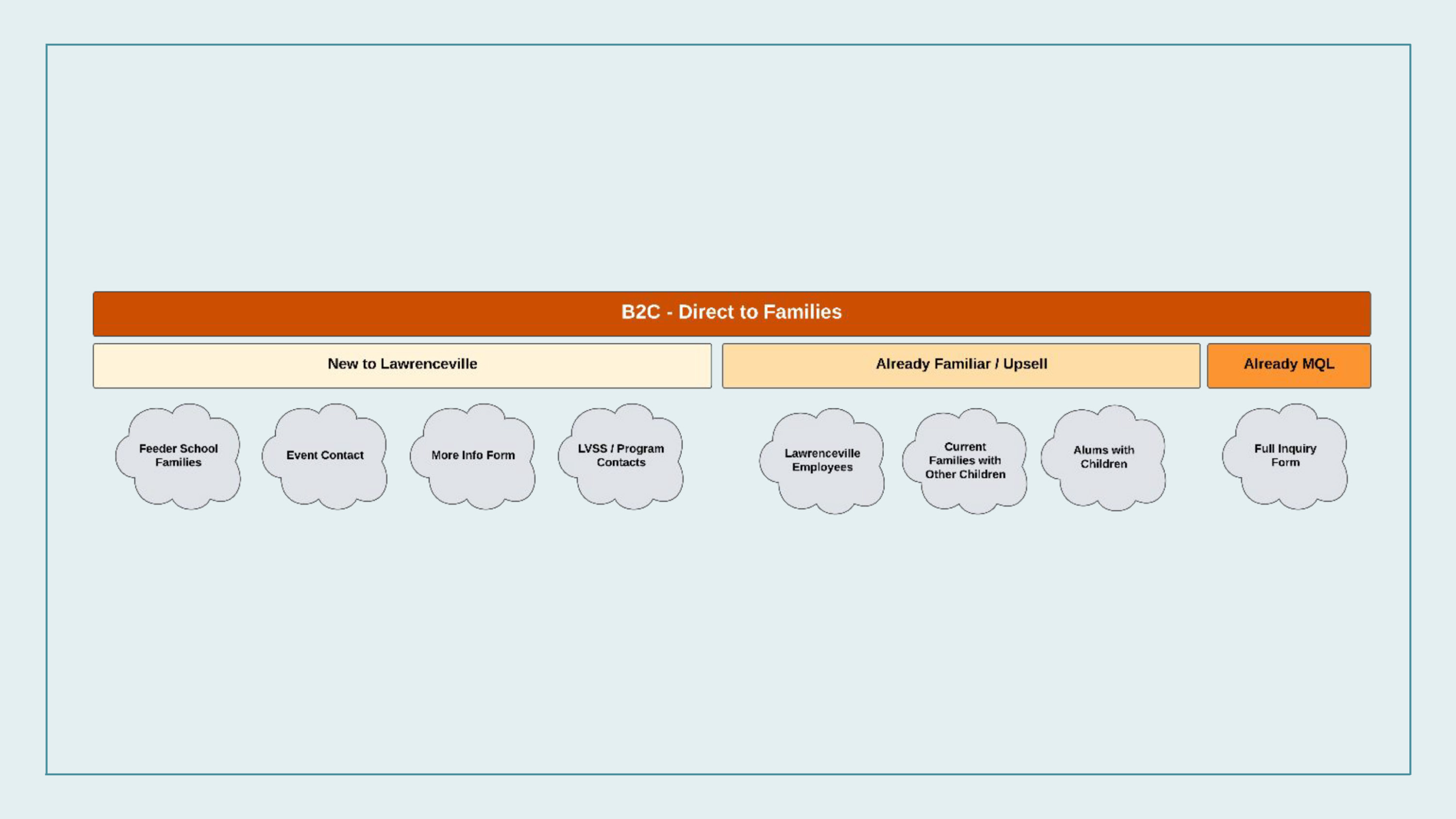
Currently, we approach all prospective families as one group. There are, however many identifiable subsets of prospects. Are these families new to Lawrenceville? If so, how have we come to know about them? How can we acknowledge them to express appreciation for their part in our burgeoning relationship? How can we make them feel seen?
For families who are already familiar with or connected to the school, how can we tailor the information they receive to address their specific needs?
Lawrenceville employees don’t need information about the location of campus – sending it to them makes it feel like an anonymous process. Current families don’t need information about school operations – sending it to them makes them feel like we don’t really know them OR their child that already attends the school.
If we send prompts to people who have already submitted a full inquiry form, they may feel uncertain that their information has been received, or worse – that they wasted their time in filling out the form.
Beyond their relationship to the school, who are the people we are addressing? Are they the right people?
The brand we put out communicates the audience we WANT.
We don’t necessarily want more applications. If the number of applications increases, but none are viable, then we’re just adding noise to our own processes and creating disappointment for applicants.
We need the right users to be able to confidently identify a potential match with the school and users that are not a fit to be able to move on to something more appropriate.
If we don’t want people in our audience that have a certain value, we should tell them. We can build our desired audience by offering content that’s important to their persona.
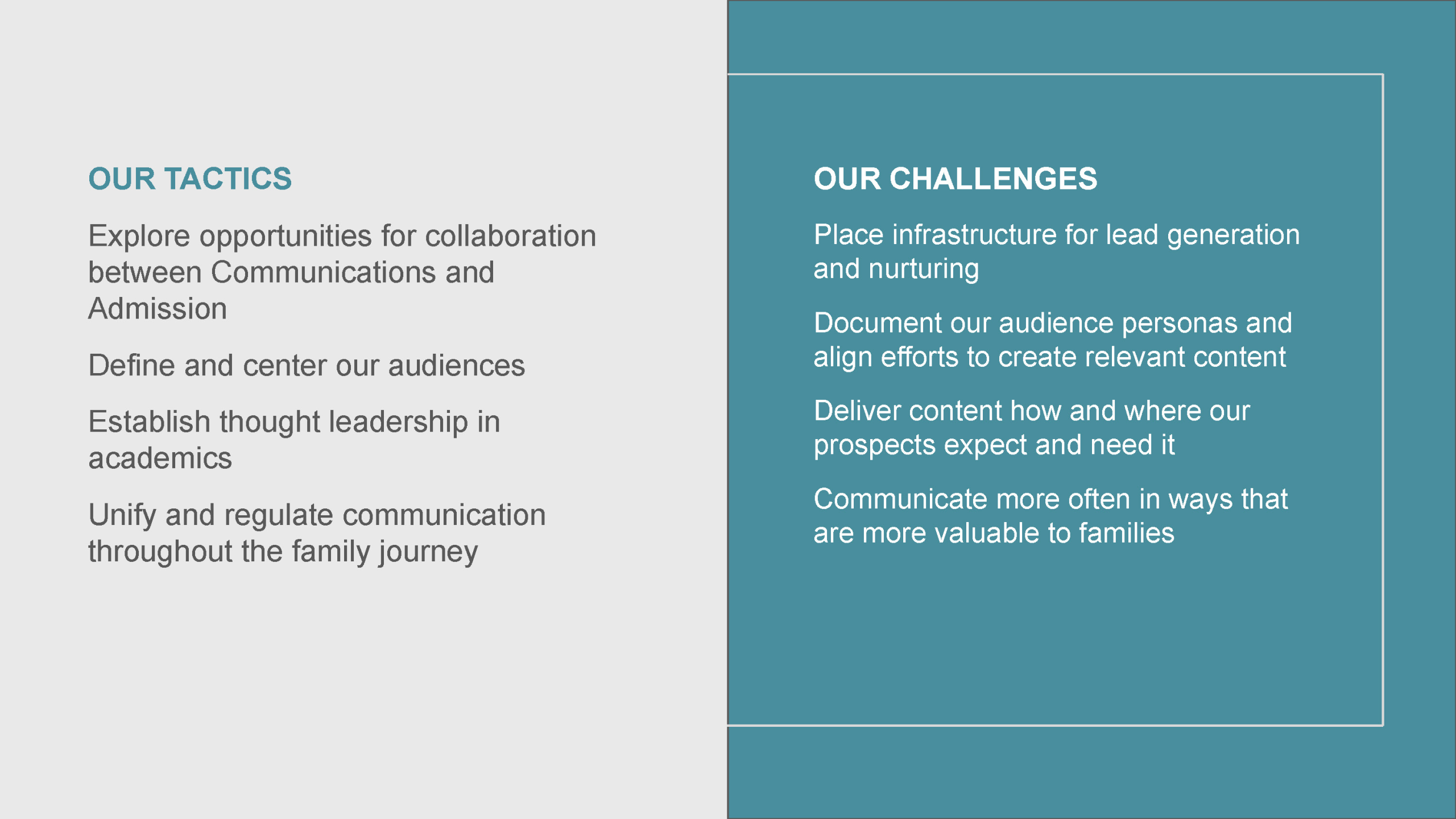
Moving toward a more comprehensive, cohesive experience for families, we can employ many different tactics to improve our communications. All of these tactics take root from a clearly defined family journey. Once we understand what it’s like for families to engage with us from their perspective, we will be able to take better control of the family experience and evaluate both our effort and impact in a more strategic light.

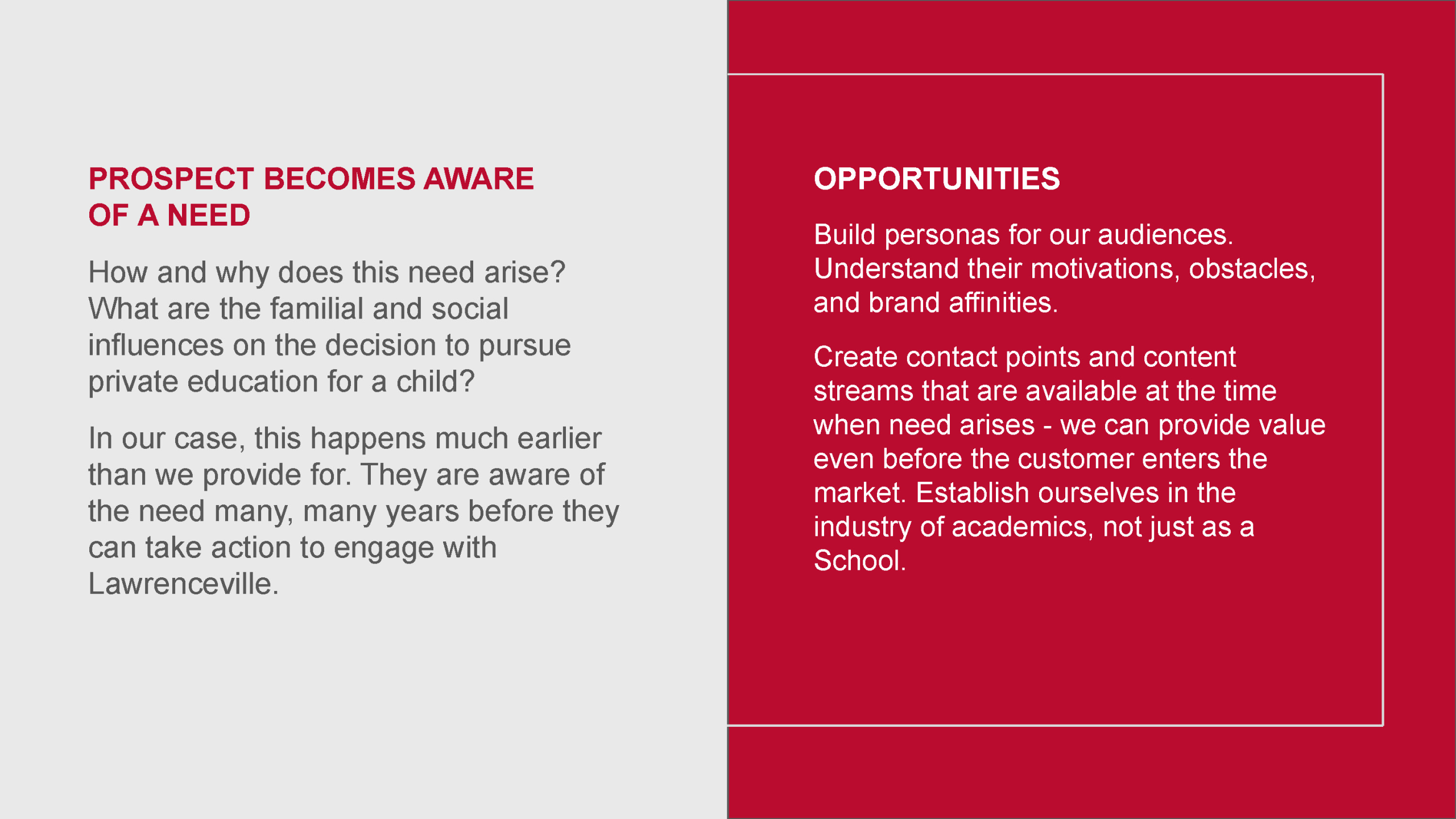
When does the family journey really start? When you have a child, not when they’re about to enter high school. As a 9 – 12 school, we have an additional challenge. We’re asking people to leave their school and come to us. They are giving up familiarity, entering a new physical environment (sometimes on a new continent), possibly beginning boarding school for the first time, and changing social relationships and the rhythm of daily life.
How can we use communication to meet this challenge? How can we minimize the concessions and risks families are making to pursue a Lawrenceville education?
The first opportunity we have is to really get to know our prospective families.
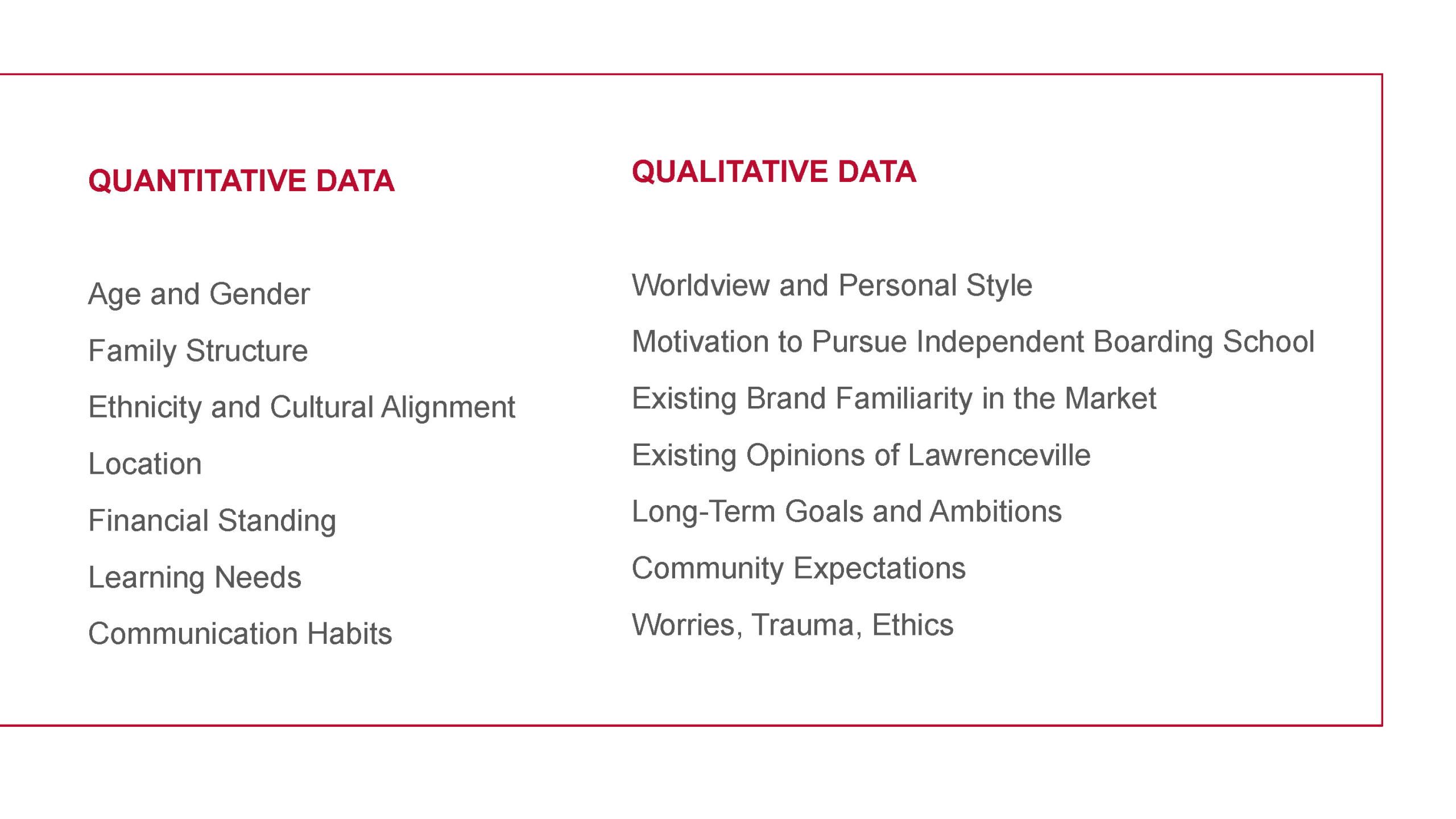
By conducting market research, both quantitative and qualitative, we can understand their motivations, obstacles, and existing dispositions and assumptions. We can begin to form a clear picture of who our families are (their demographics, locations, financial standing, learning needs, and cultural alignment) and how they think and feel as they search for a high school for their child (through interviews, opinion surveys, focus groups, observing tours, etc.).
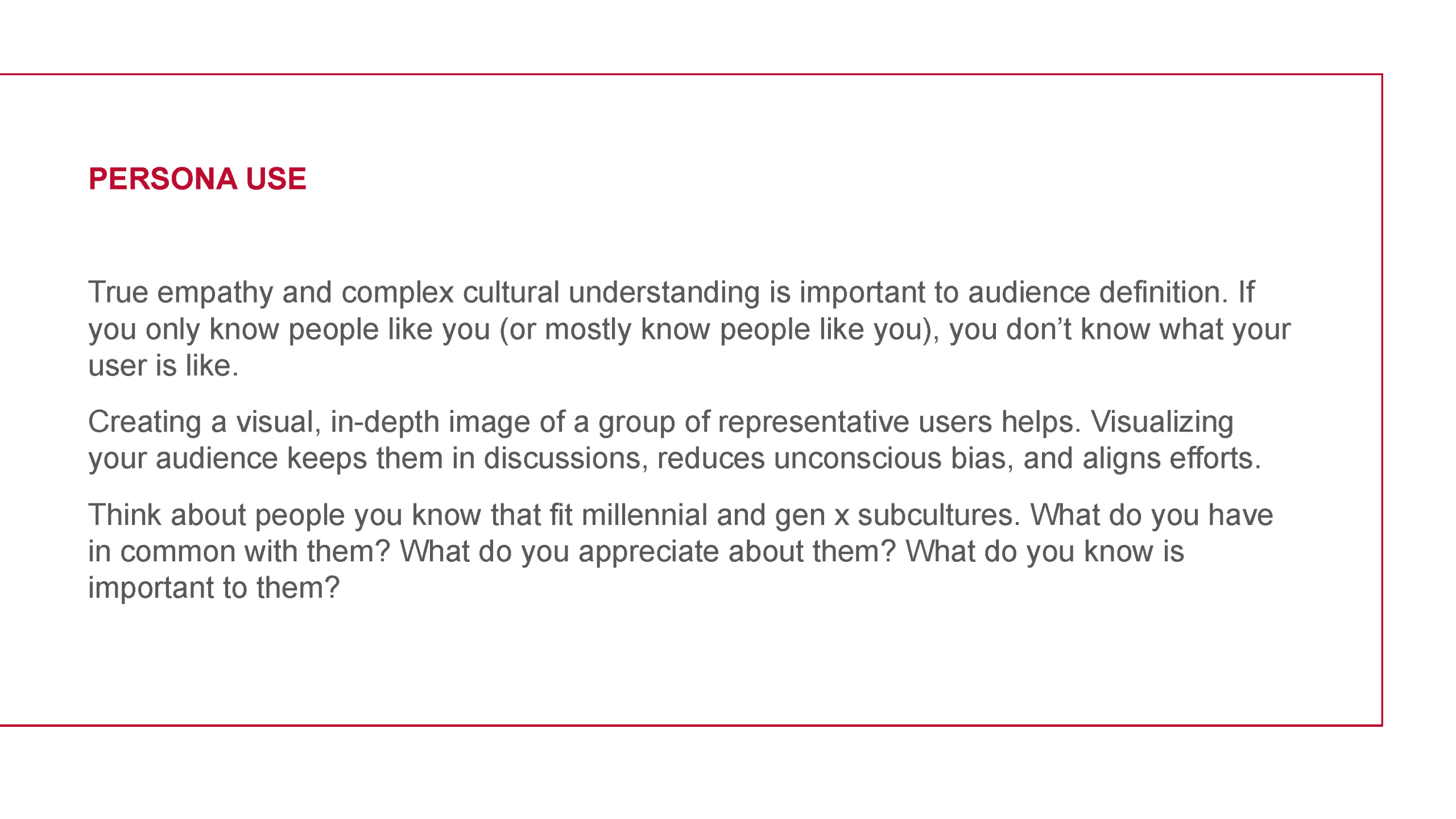
True empathy and complex cultural understanding is important to audience definition. If you only know people like you (or mostly know people like you), you don’t know what your user is like.
Creating a visual, in-depth image of a group of representative users helps. Visualizing your audience keeps them in discussions, reduces unconscious bias, and aligns efforts.
Think about people you know that fit millennial and gen x subcultures. What do you have in common with them? What do you appreciate about them? What do you know is important to them?
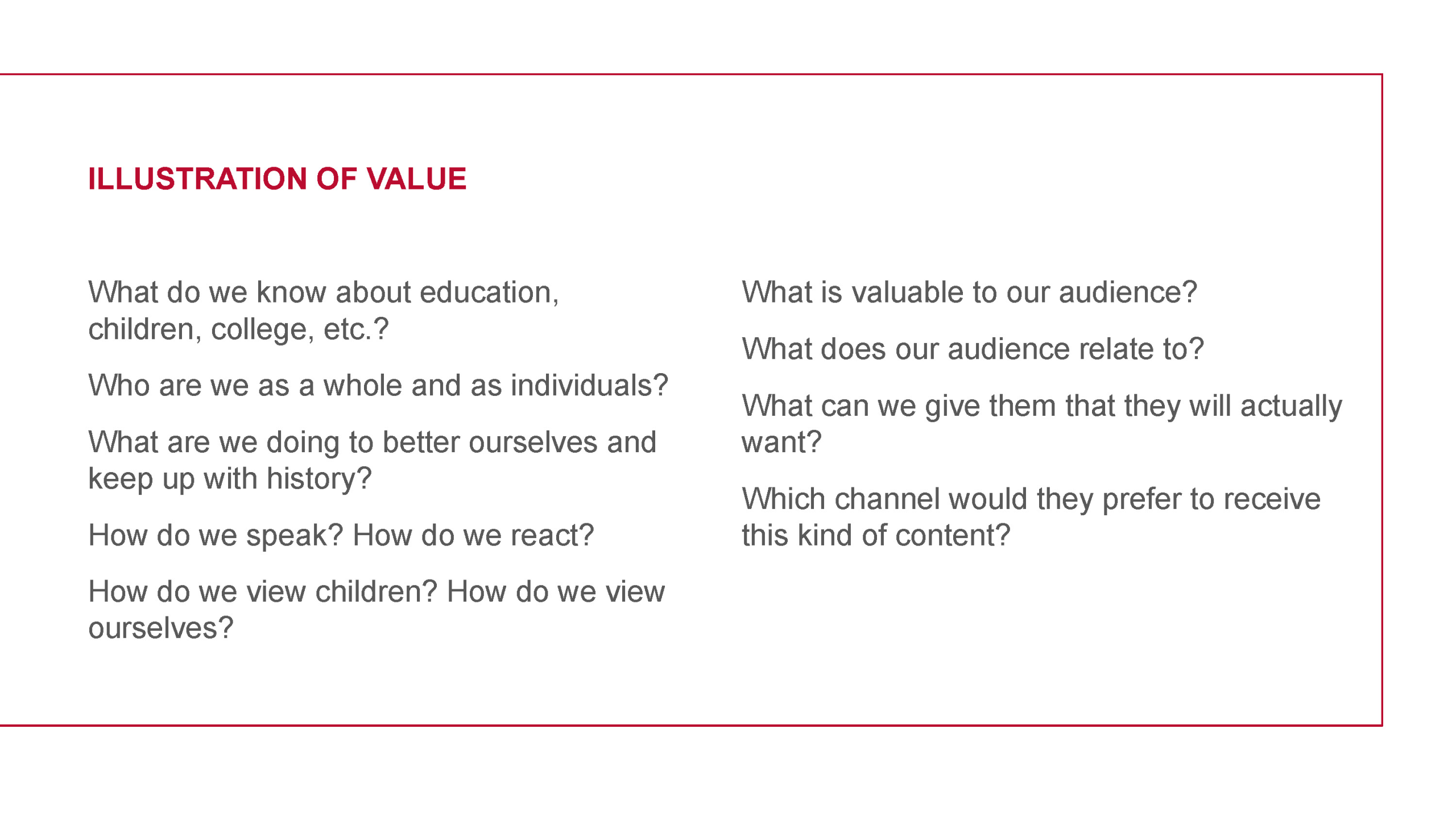
Then, of course, we need to show our families that we both understand their needs and have the expertise to address them. We need to maintain consistency and directness in our communications and consciously center our prospective families – it’s not just about what we want to tell people, it’s about what people need to know in order to make a decision.
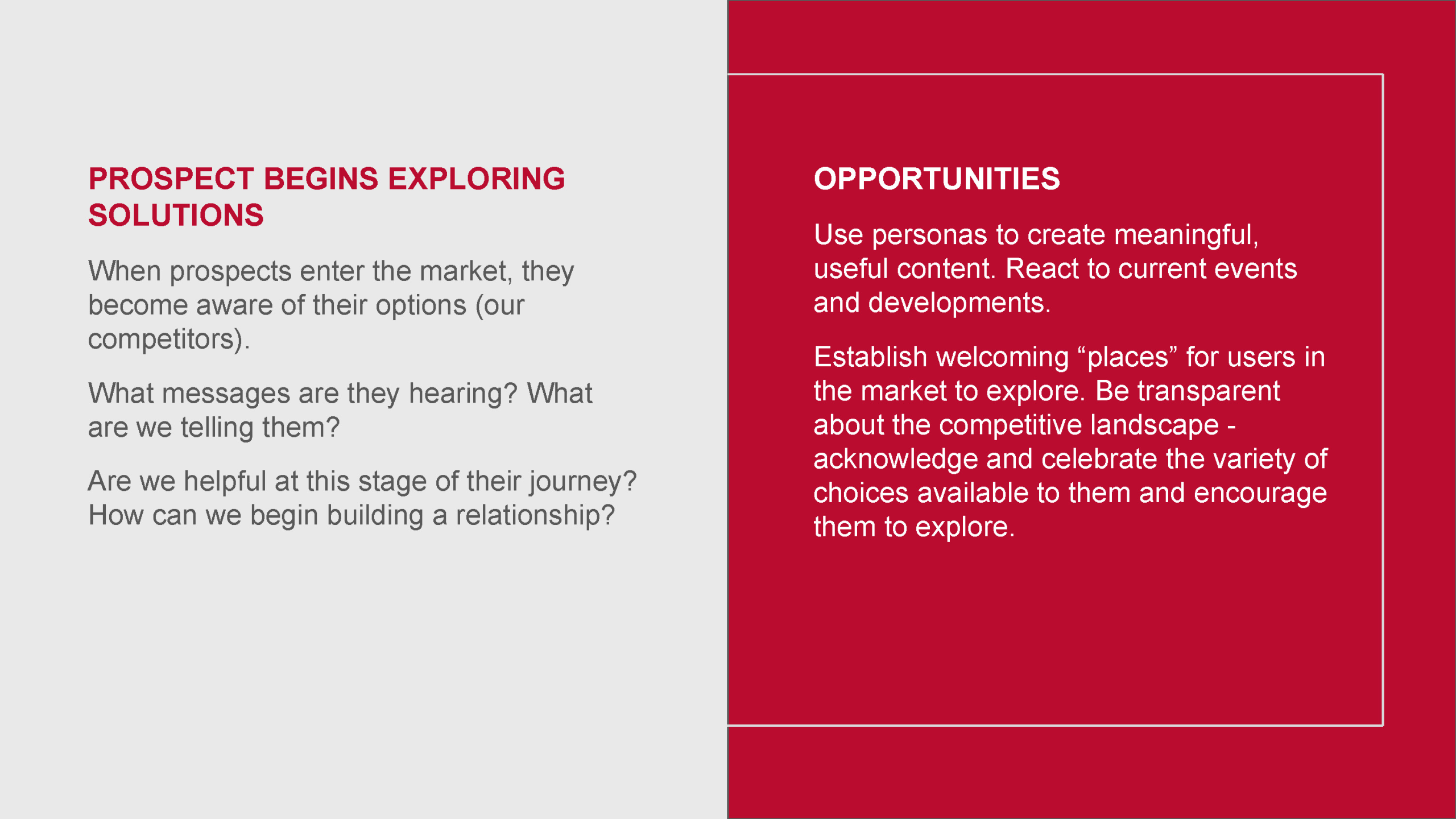
Suddenly, we’re not alone. Prospective families will see us only alongside our peer schools – and there are a lot, right?
Over the past 10 years, 10% of our new website users come from school review and ranking sites. That 10% represents people who have not visited our website until clicking through from a site like Niche.com. 10% may not sound super substantial, but it does equate to about 39,000 new users each year. What causes a user to click through to our website? There’s a great opportunity here to review our content on these directory sites through the lens of the personas we created in the last step.
Of course, having our directory profiles current and complete is very important. But, it’s still a passive presence. We’re not engaging our audience beyond identifying ourselves. If a family with a child in 7th grade or below tried to contact us through a directory site, they will be put off until their child is ready to enter the admission cycle. If we created an avenue for families earlier on in their journey, we have the opportunity to illustrate value, set ourselves apart from our competitors, and establish a documented history of engagement and authority within the academic community.
Frankly, we are doing great with branded search engine results. The bulk of our traffic comes from brand-specific terms, but by producing content that speaks to our core competencies, we will begin to see users coming in from other sources (professional and academic publications, parenting resources, expanded social media, and infographics). By producing content that is published to channels other than directory sites, we will gain the ability to surprise people – to show up in their natural media habitat and give them something of value.
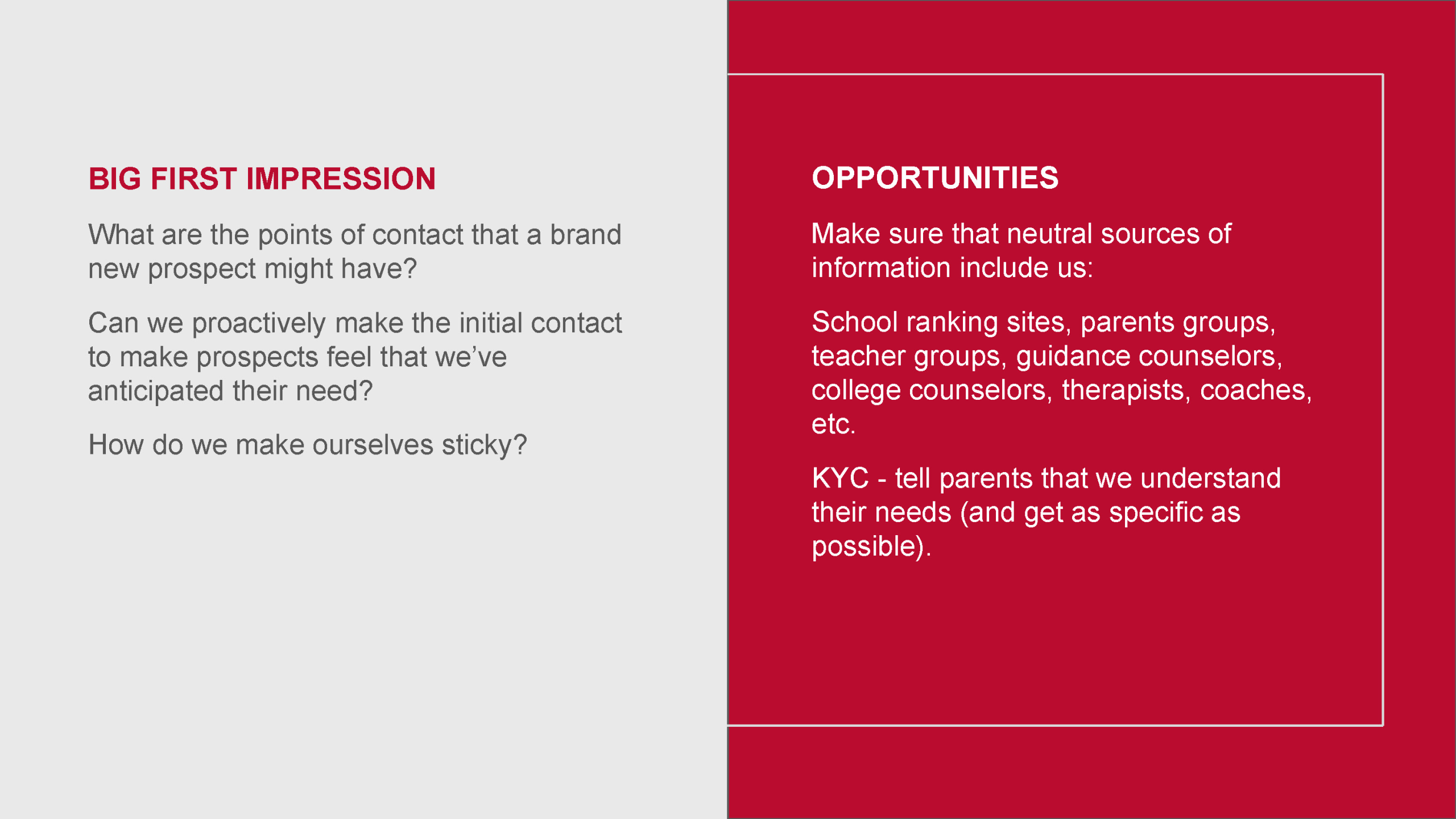
When prospective families first encounter our content, we need to make sure we know what they’re going to see.
While it’s a difficult task, we need to approach the high school admission process from a new family perspective. Using an outside consultant may be the best way to conduct this audit. We need to know what information is available about schools in general and where information about Lawrenceville is placed among it. When the search for a school turns into a search for information about OUR school, what is there to tell families that we understand what they are looking for and want to help them make their decision?
Are we being mentioned by the right organizations? Are we familiar to families’ connections that may aid in making a decision about their child’s education?
By conducting an audit, we will be better able to identify and address our content on referral platforms and make sure it connects seamlessly with information on our platforms.
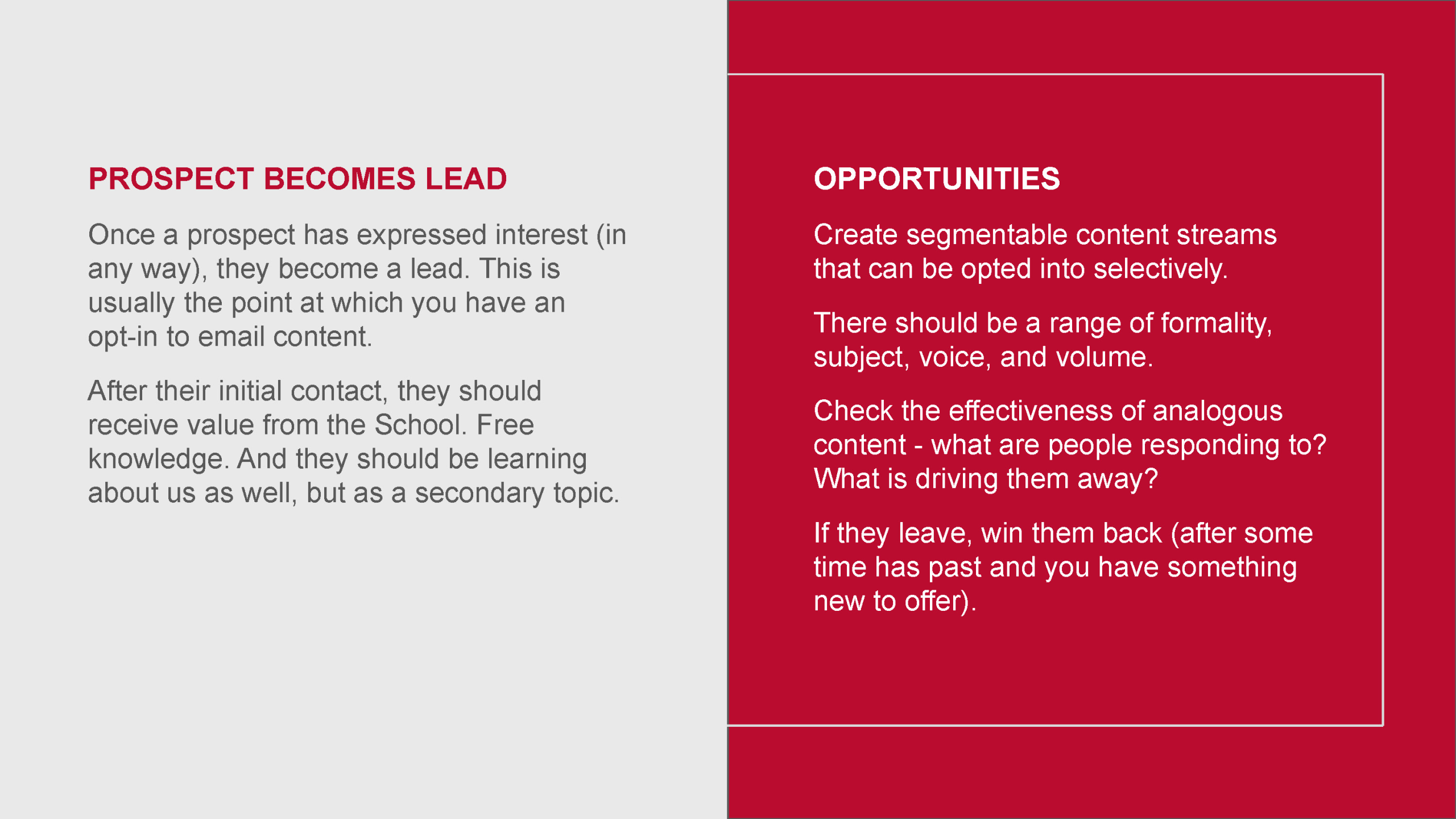
This is the stage at which the audience segments mentioned earlier will come into use. Prospects may become leads in different ways. The means by which they came to be a lead should be acknowledged and spoken to in our outreach to them. We should be paying attention to which content effectively creates engagement and consistently tailor our content from a prospect’s perspective. It’s more important to know what people WANT to know about the school than what WE want them to know.
While we should offer content that appeals to specific audience segments, the content can originate from common documents and repurposed for different channels.
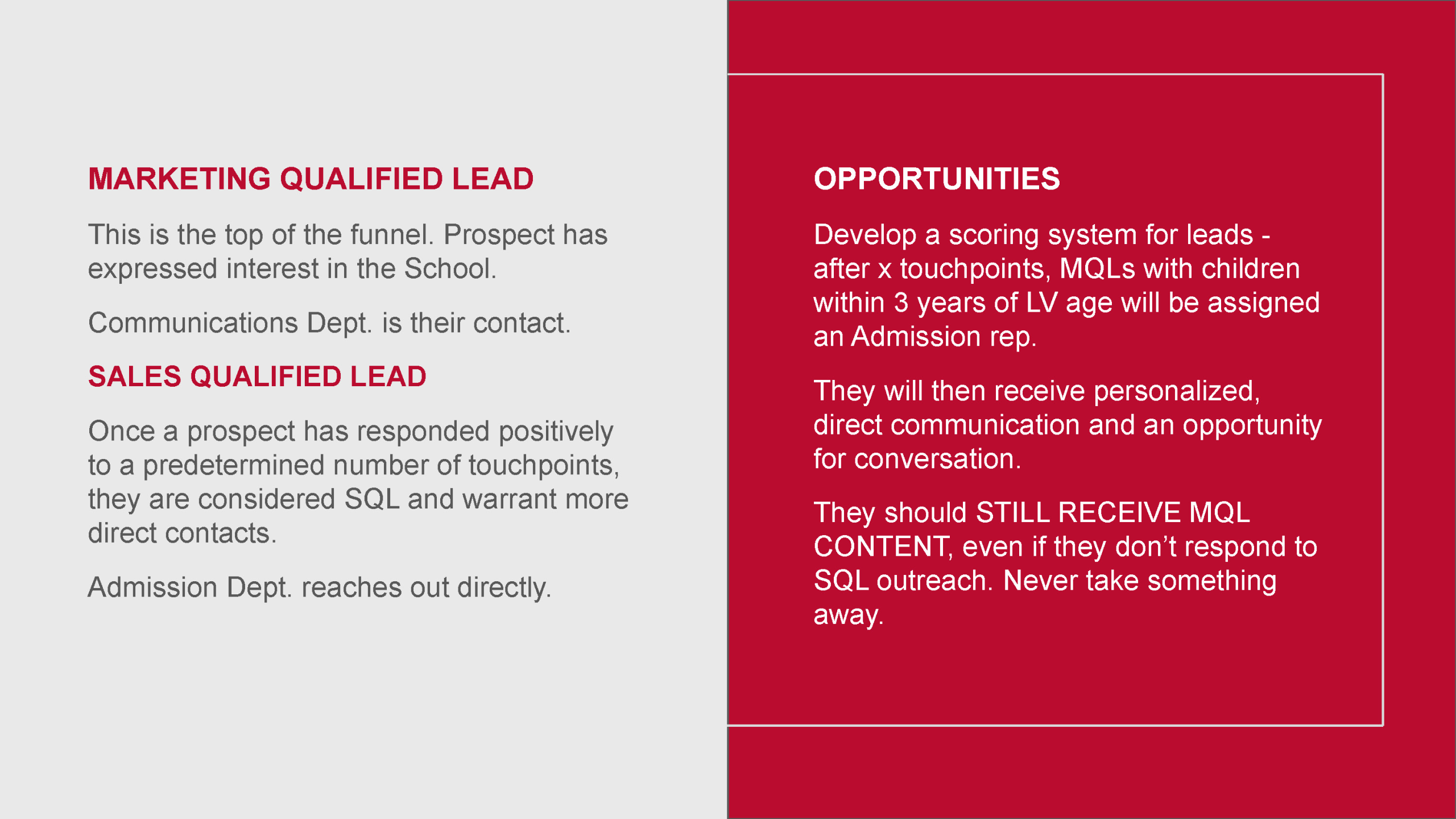
In terms of the prospect moving through a funnel, we can establish scoring and chain of custody for communications and engagement. There should always be a no-strings-attached source of value for the prospect. Even if they disengage with more direct appeals, they should still receive value. Our desire to improve the lives of families should not be conditional on their level of engagement.
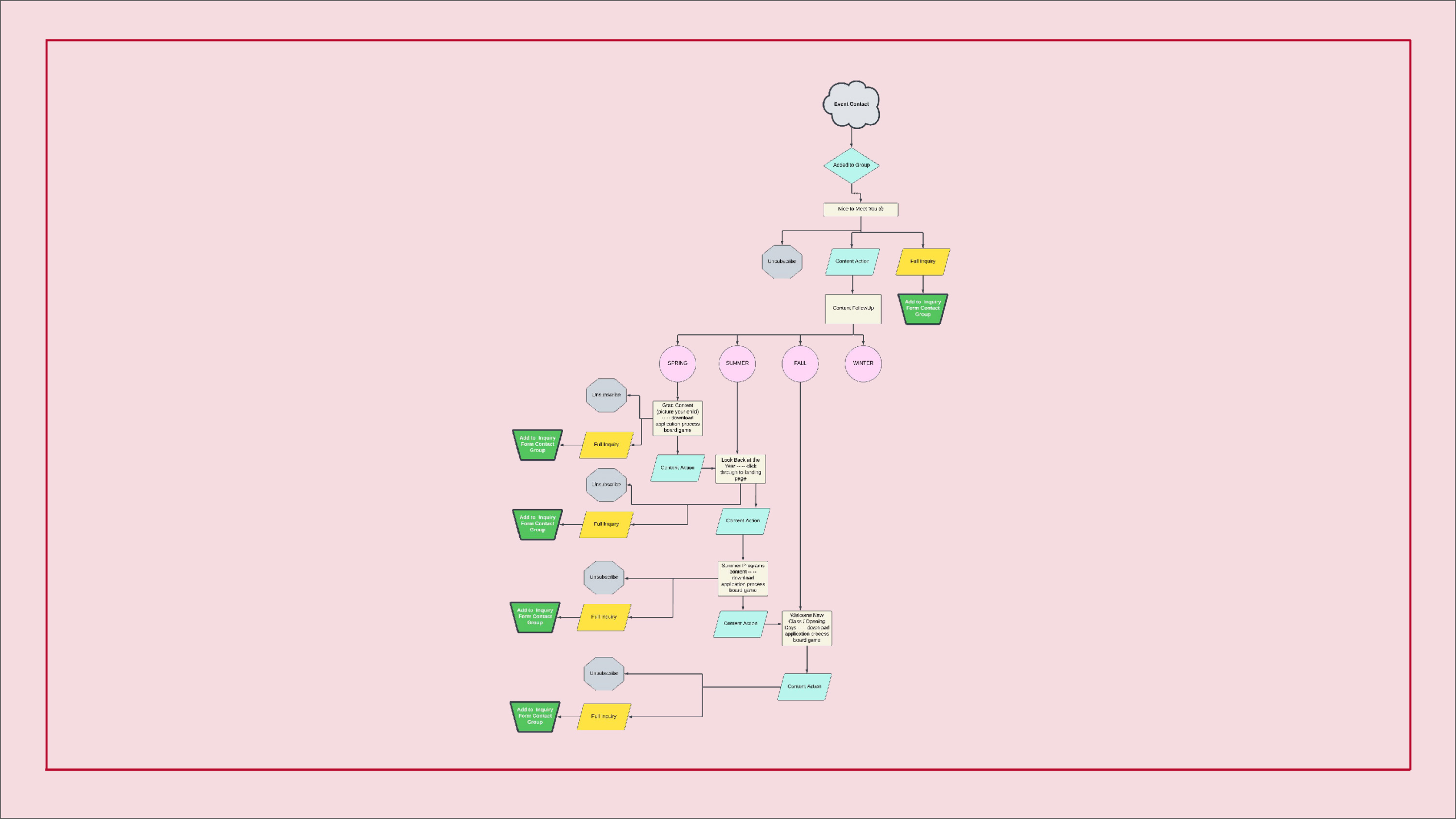
Here is an example of an email communication plan for prospective families that were introduced to Lawrenceville at an event.
The chart shows the contact entering a segment of our email list, then receiving content based on the time of year they enter the segment. When they are presented with content, they can engage with it, complete their inquiry form (which will mark them as SQL and move them to another segment that more closely follows the admission cycle, or unsubscribe from Lawrenceville email.
The content they receive will be conditional on the current term when they enter the segment. It can be prepared ahead of time and repurposed from year to year.
Within this flow, prospects will be scored based on their level of engagement and moved to other segments as appropriate.
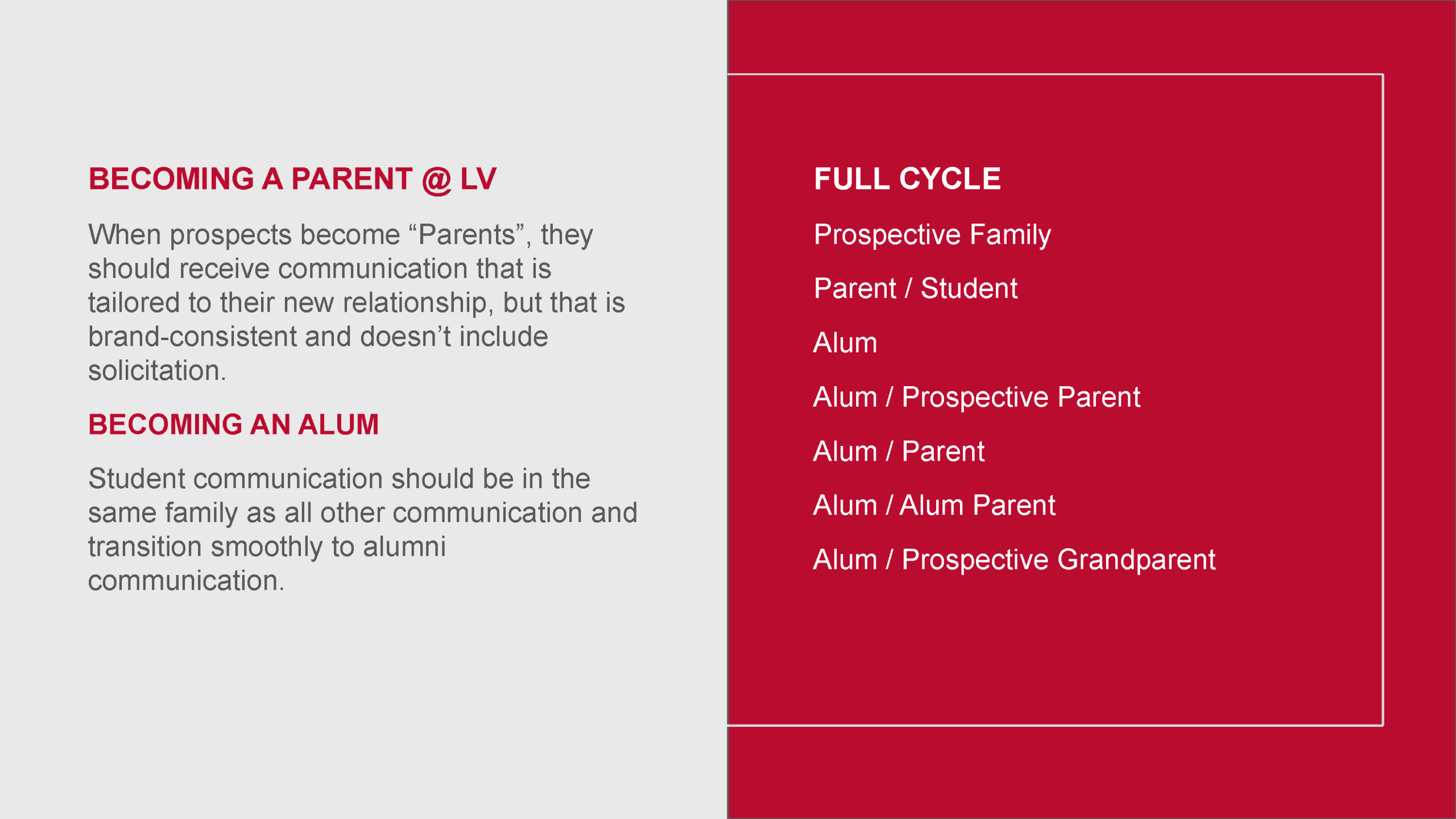
Finally, we have an opportunity, through collaboration with central communications, to unify the family journey from unknown prospect through the life of the student, alum, and beyond.
When we keep in mind that the prospect’s experience with Lawrenceville goes far beyond the admission cycle, we have a better understanding of where that experience should start and how it needs to evolve over time.

Data is not a product. It is information that requires context, critical thinking, and empathy to employ.
It’s important to design our metrics based on user behavior. When looking at raw data, we can find patterns in cross-referenced, readily available data sets to sort of triangulate conclusions, but they will never be as sound if they were not built into the original process.
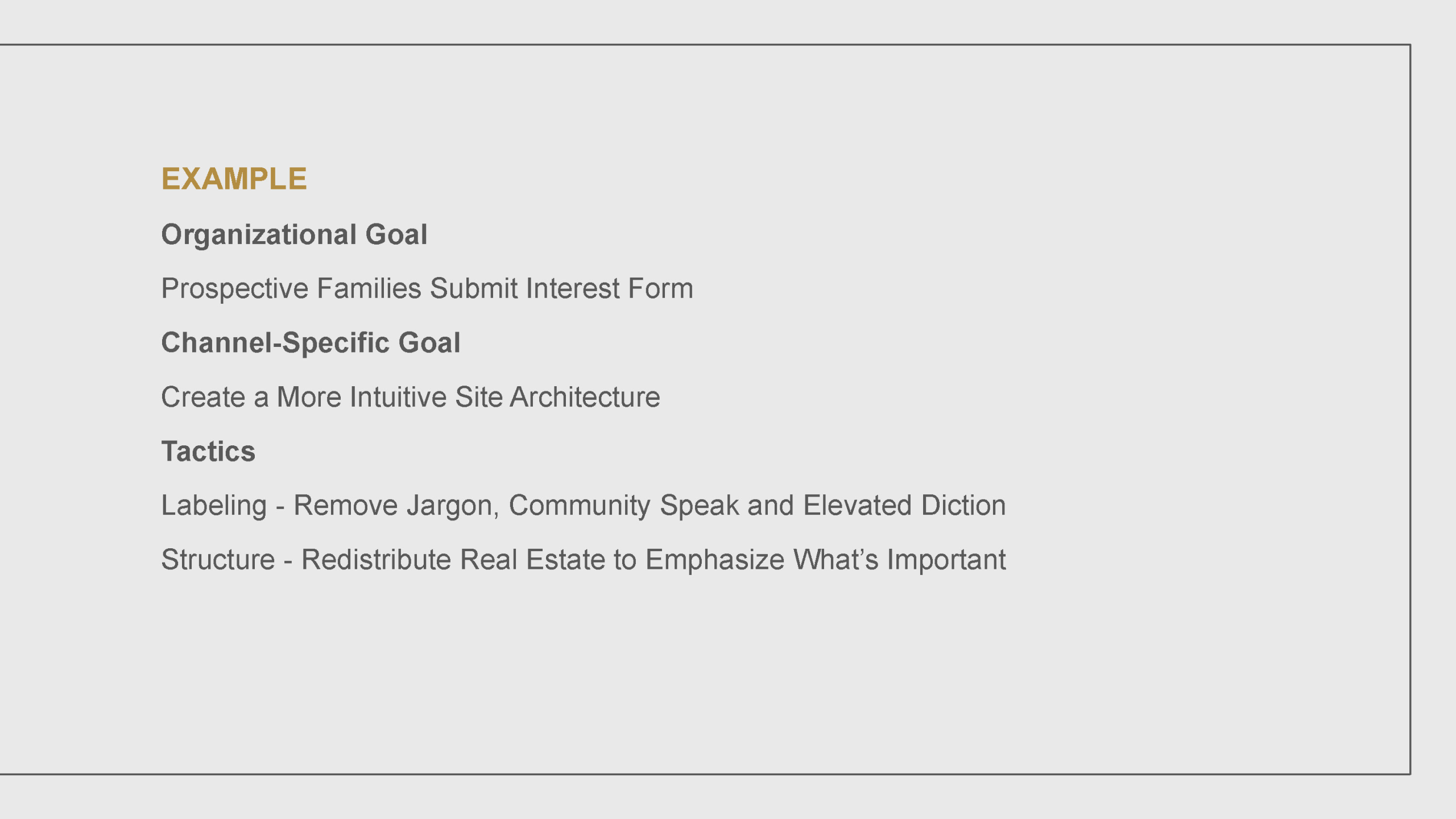
Let’s look at an example of a project without baked-in metrics.
Beginning in 2019, we began a website refresh. The organizational goal it was aligned with was getting prospective families to submit an Inquiry Form.
For the website, this meant clearing a path, but getting the necessary information in front of users so that they could reach the form in a reasonable amount of time in a state where they are prepared to submit it.
Our tactics were adjusting our navigation labeling and changing the structure of the website.
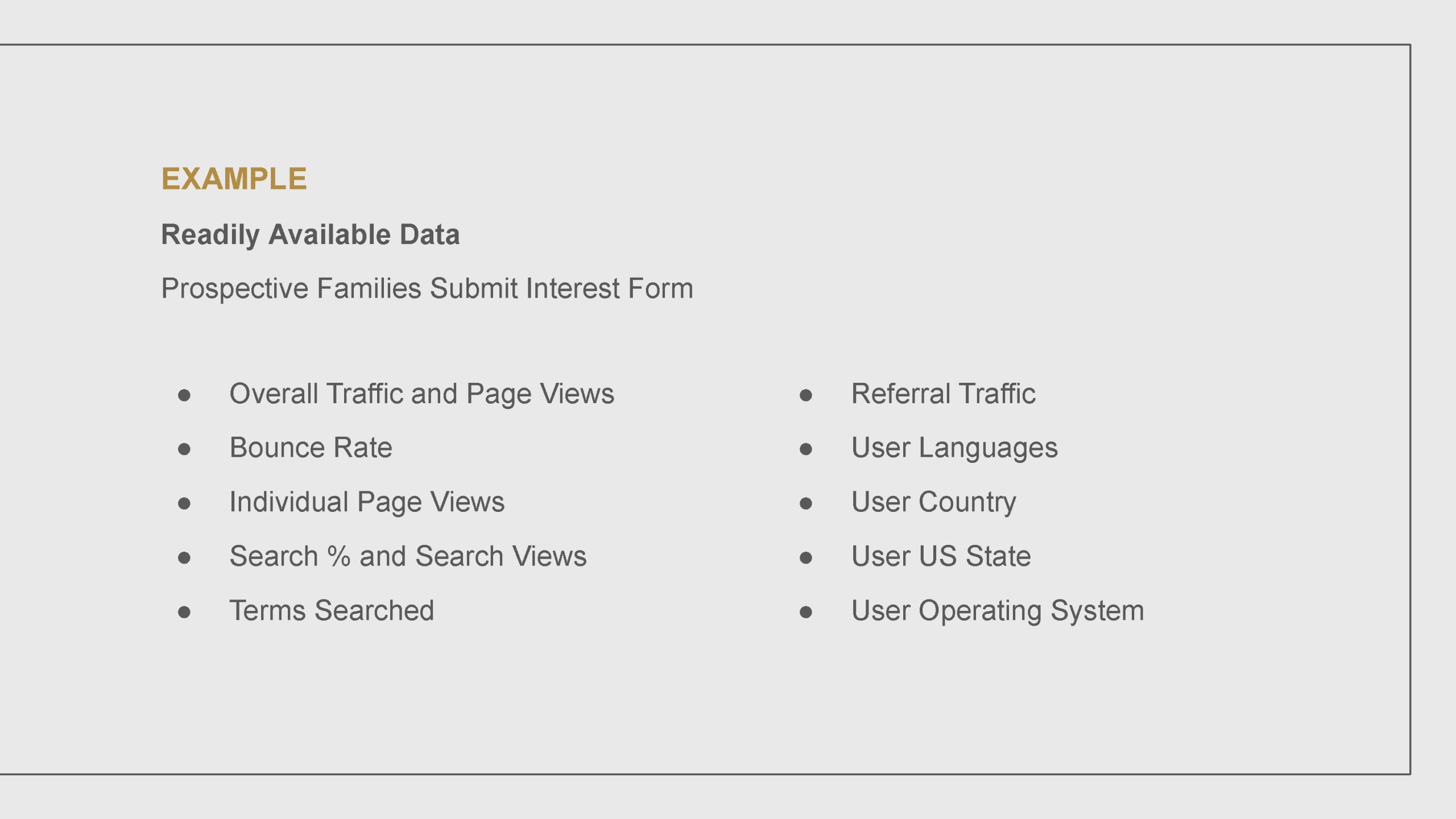
We decided to count this as a common-sense initiative and used only existing reports to look at the site’s traffic.
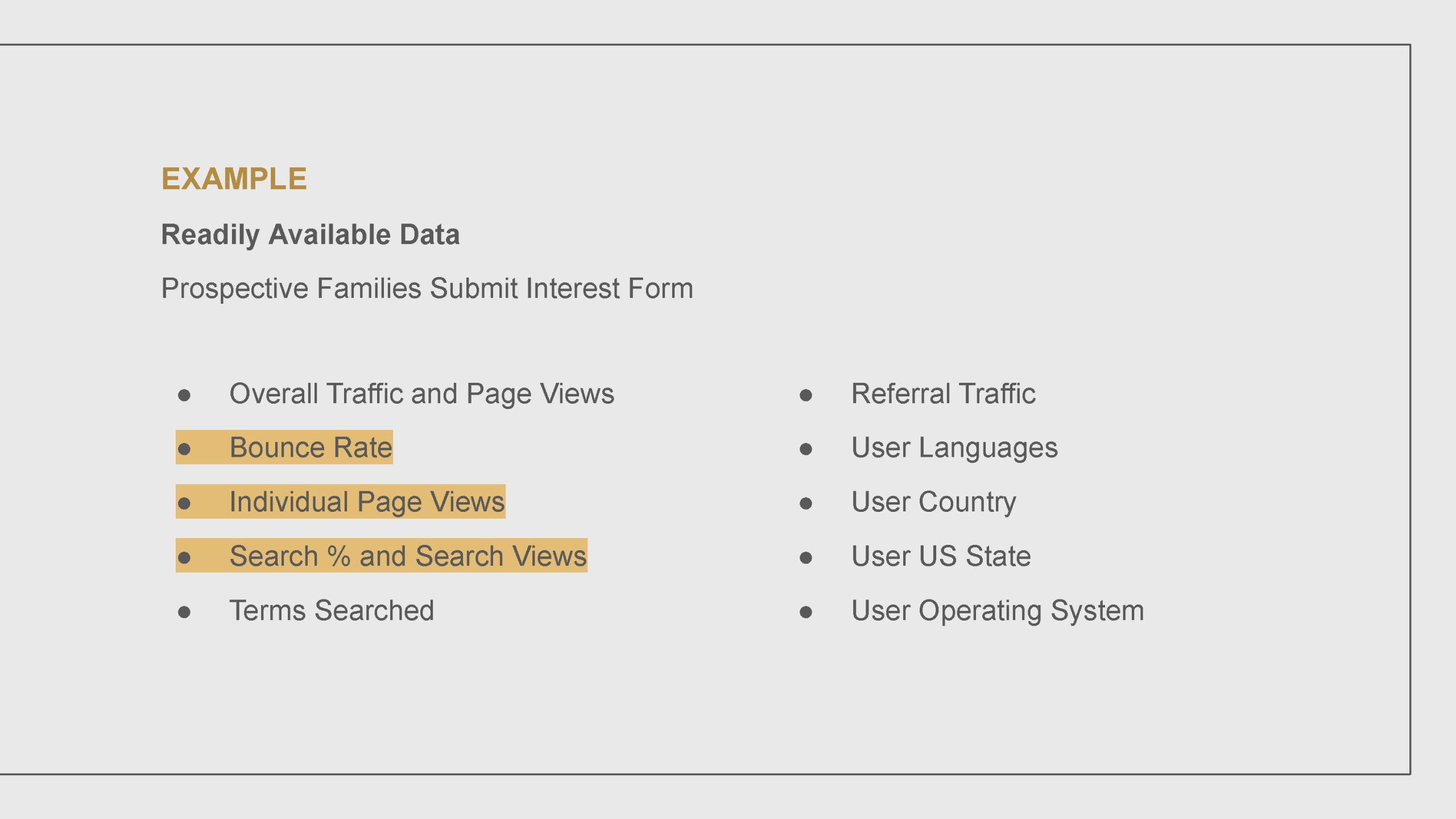
Highlighted in yellow are the individual data sets that can give insight into the success of our tactics.
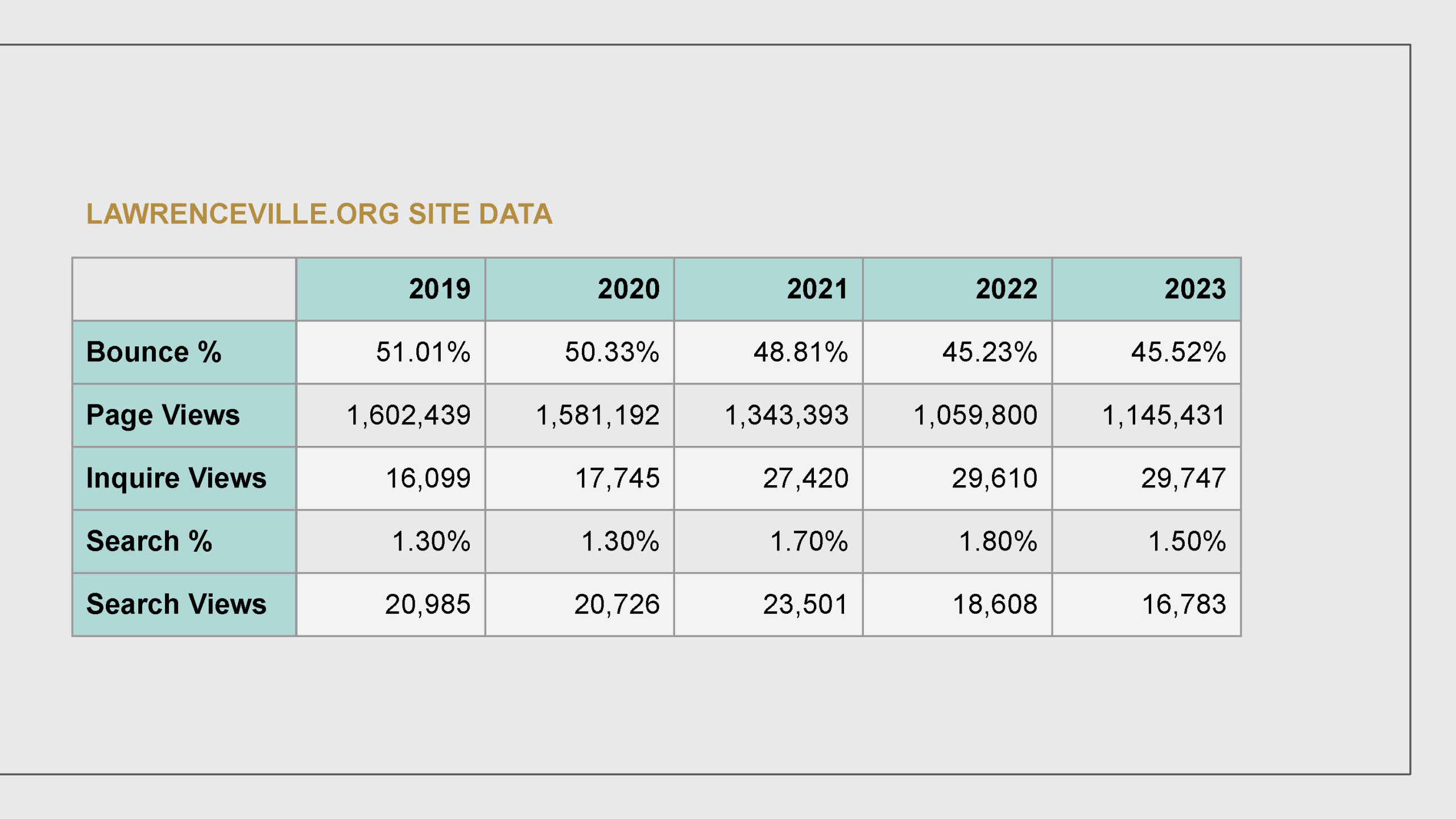
This is a set of report data from years before and after our restructuring project.
Let’s look closer…
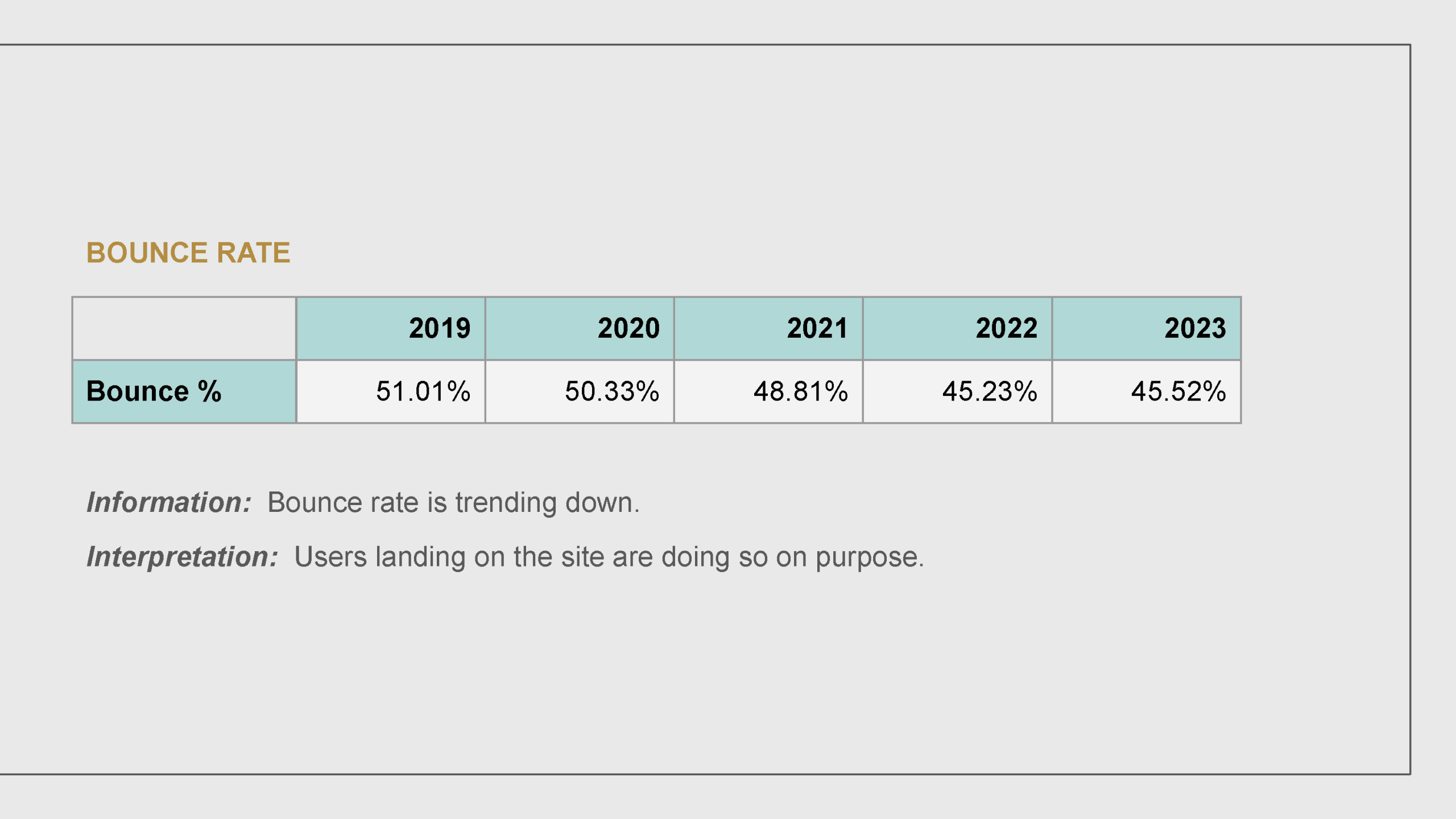
Bounce Rate is the proportion of users that did not stay on site for a significant amount of time. This means that they didn’t submit an inquiry form and the page they landed on wasn’t what they were looking for.
The bounce rate trending down tells us that users landing on the site are doing so on purpose.
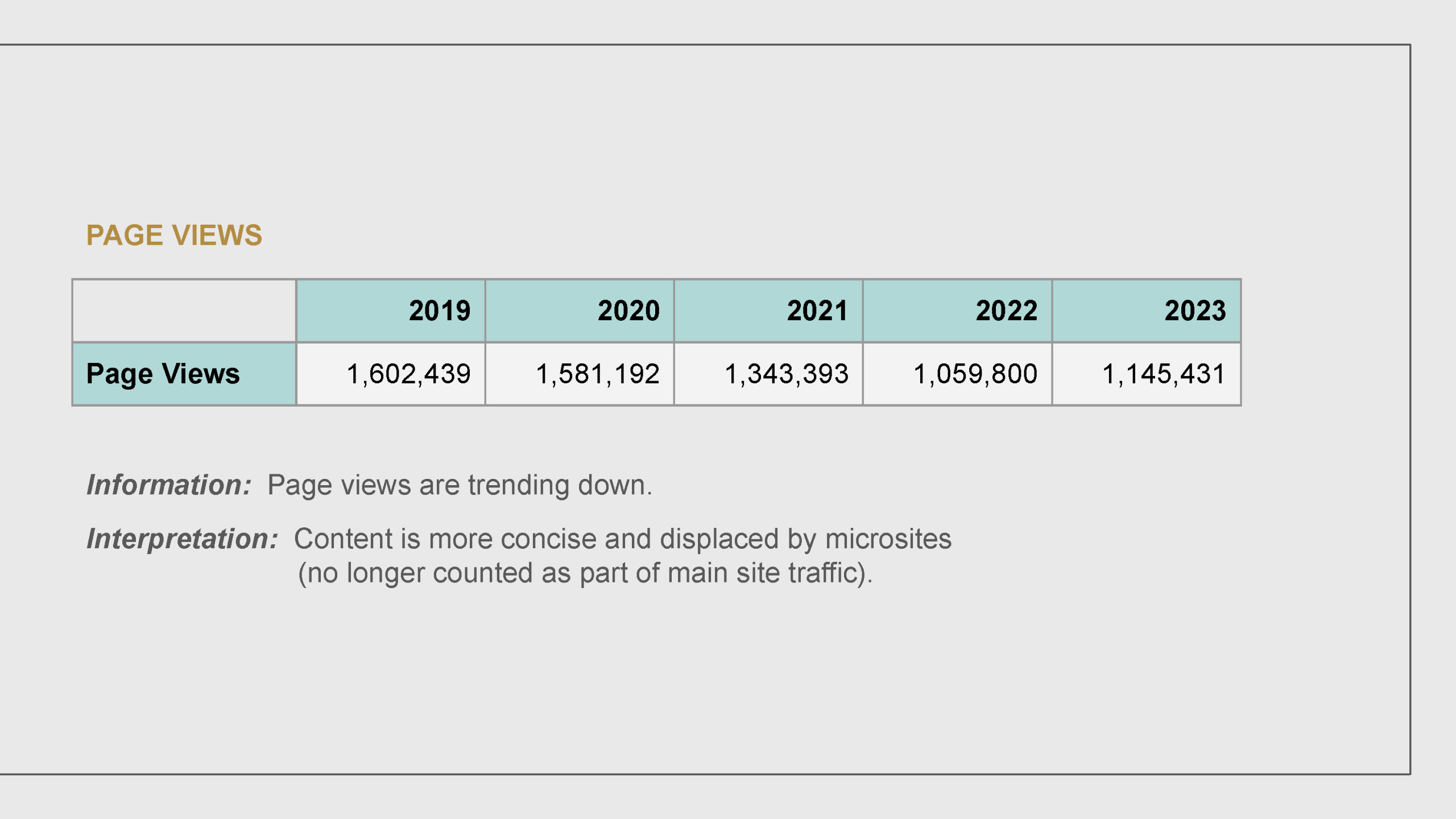
Page Views are the number of individual pages that have been visited, not the number of users that visited the site.
The number of page views is trending down. This is partially due to content being displaced onto microsites, and partially because content is more concise across the board.
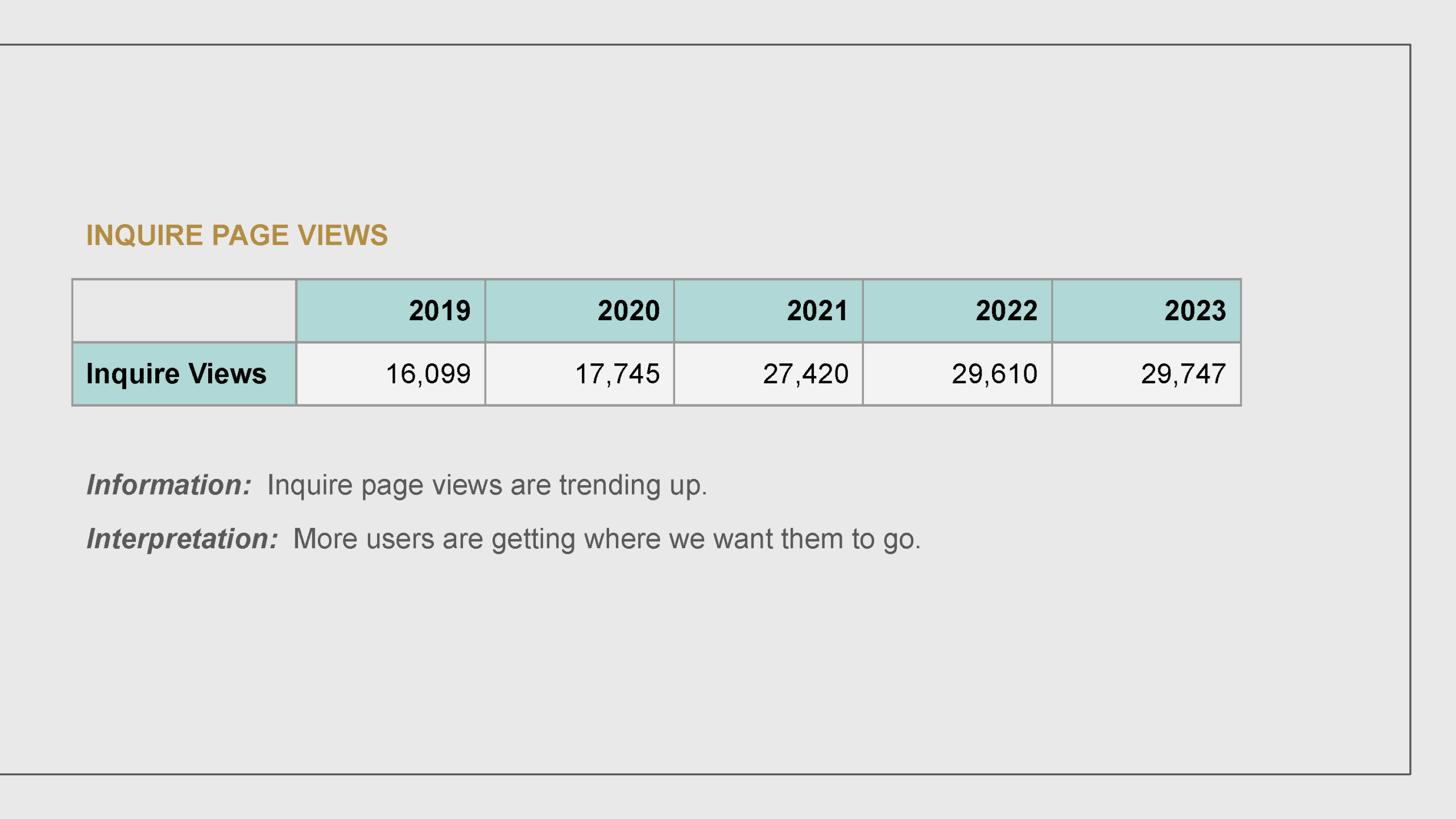
Inquire Page Views are the number of times the Inquire Page was visited.
Inquire page views trending up tells us that more users are reaching the page we need them to see in order to engage with the school.
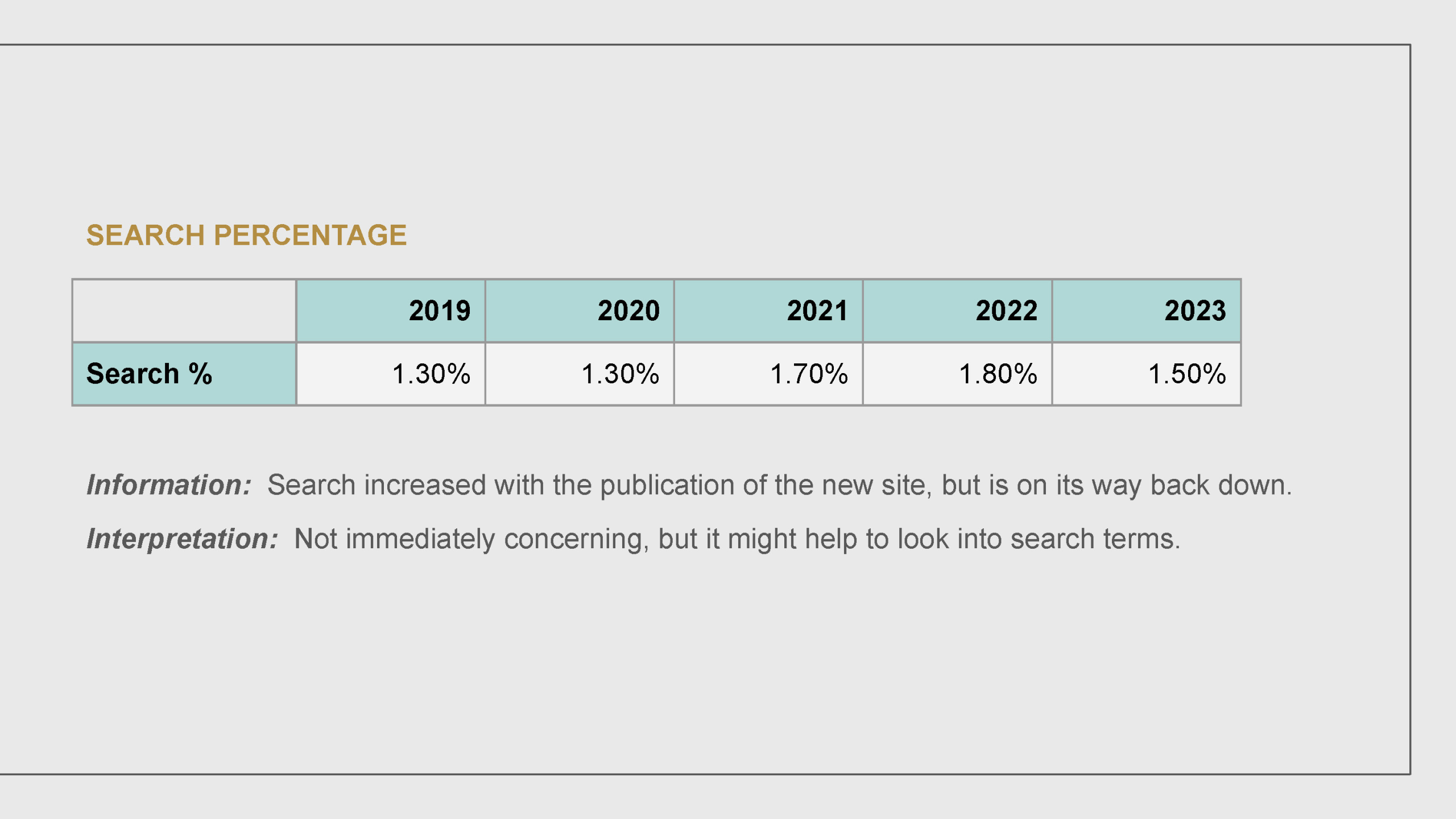
Search Rate is the proportion of users that used the search bar while viewing the site.
Search increased with the publication of new sites, but is on the way back down. This is not immediately concerning, but it tells us that we should continue to pursue information about search.
Which terms are being used? Can we tell if search is being used more by community members or the public? Is there something that is frequently searched that we made a significant change to?
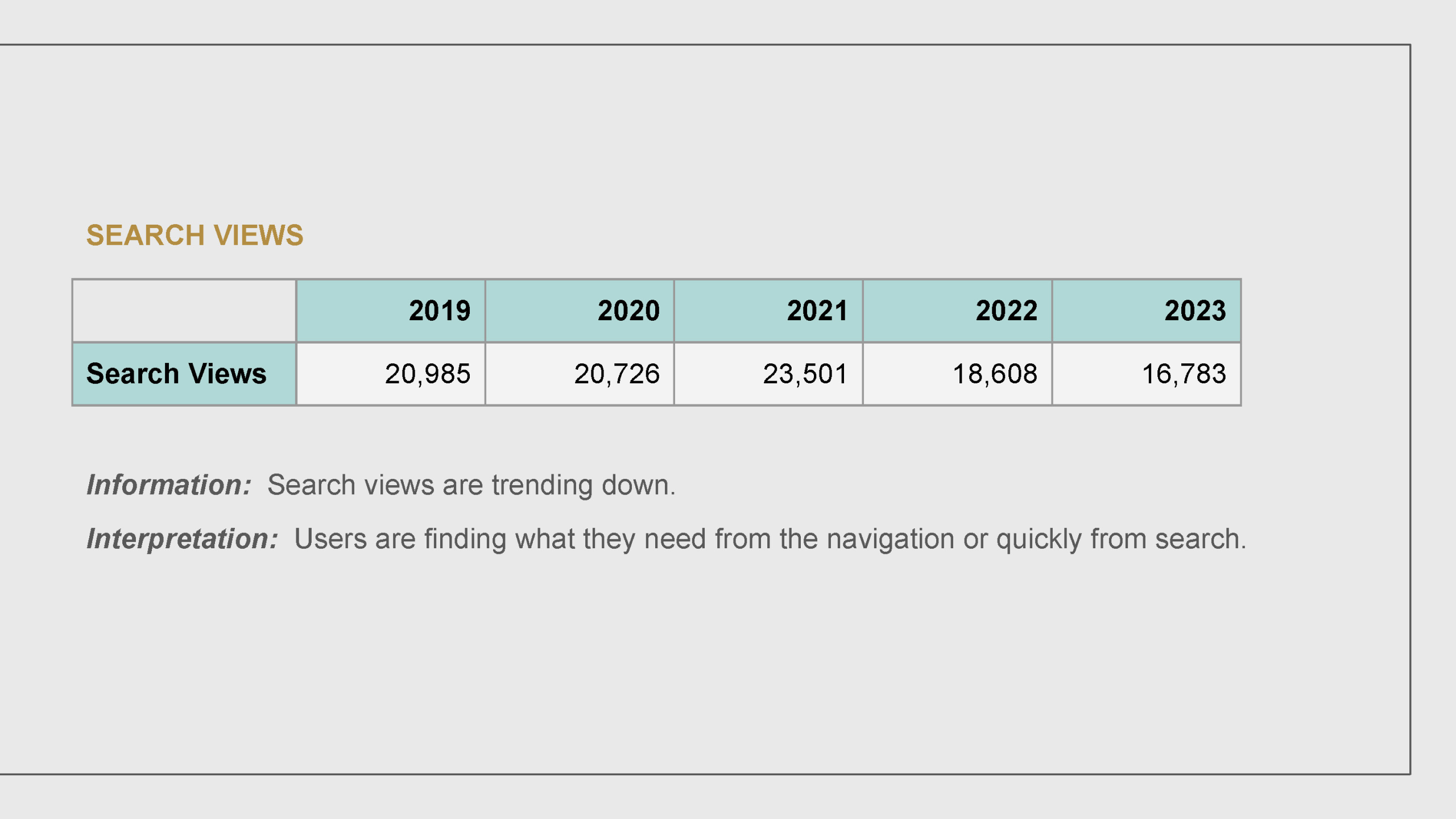
Search Views are the number of time any page with search results was viewed. This includes views of “page 2” of search results, not just the number of searches performed.
Search views trending down tells us that – if users are still searching – the results of searching are more relevant and lead users to the content they are looking for quickly.
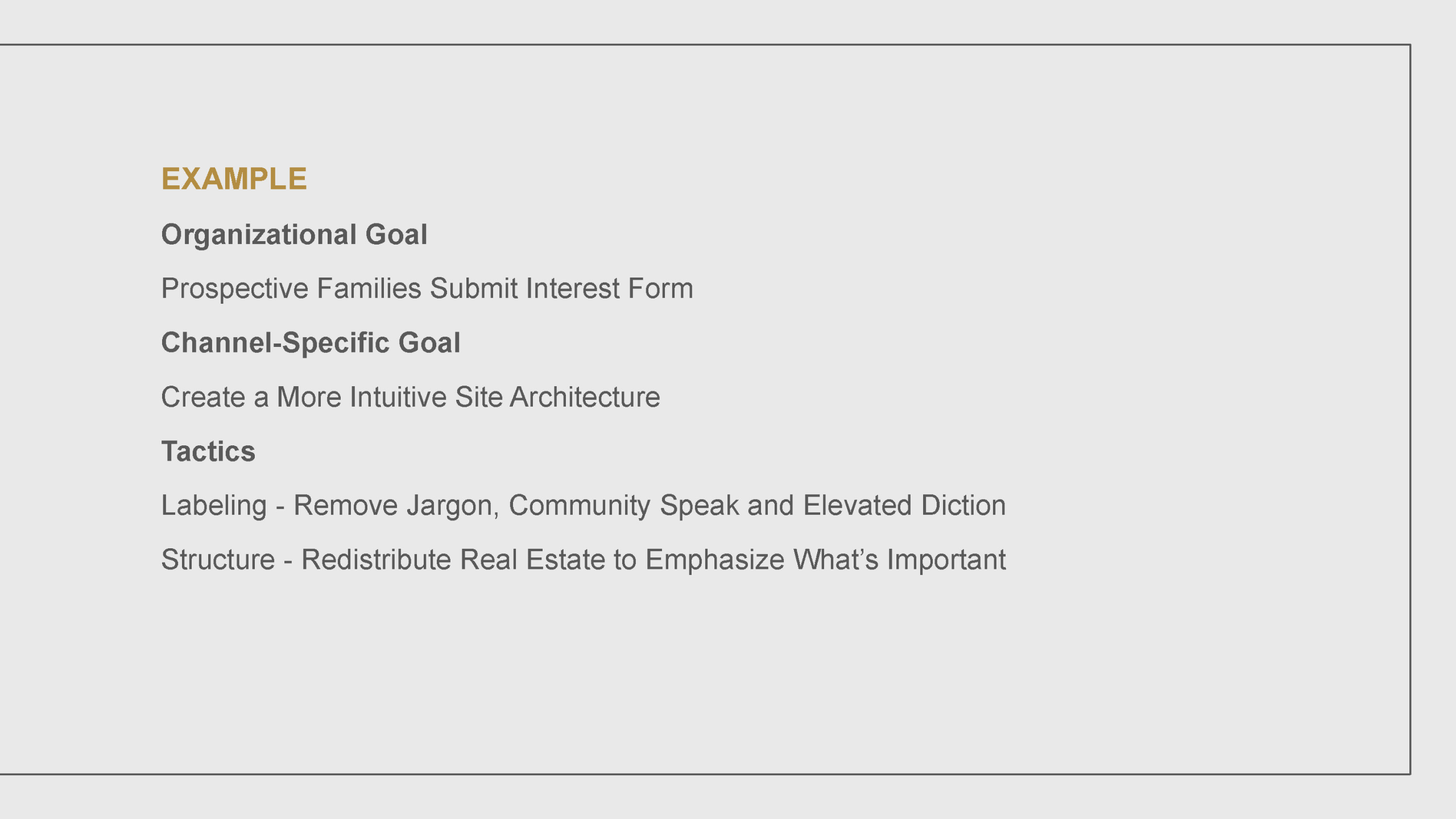
Going back to our goals, then, we can see that although the reasoning is there, we may not be able to come to a conclusion about the success of our project using out-of-the-box reports.
We are often biased toward our own logic and will interpret data to confirm our success, even if our conclusions are specious at best.
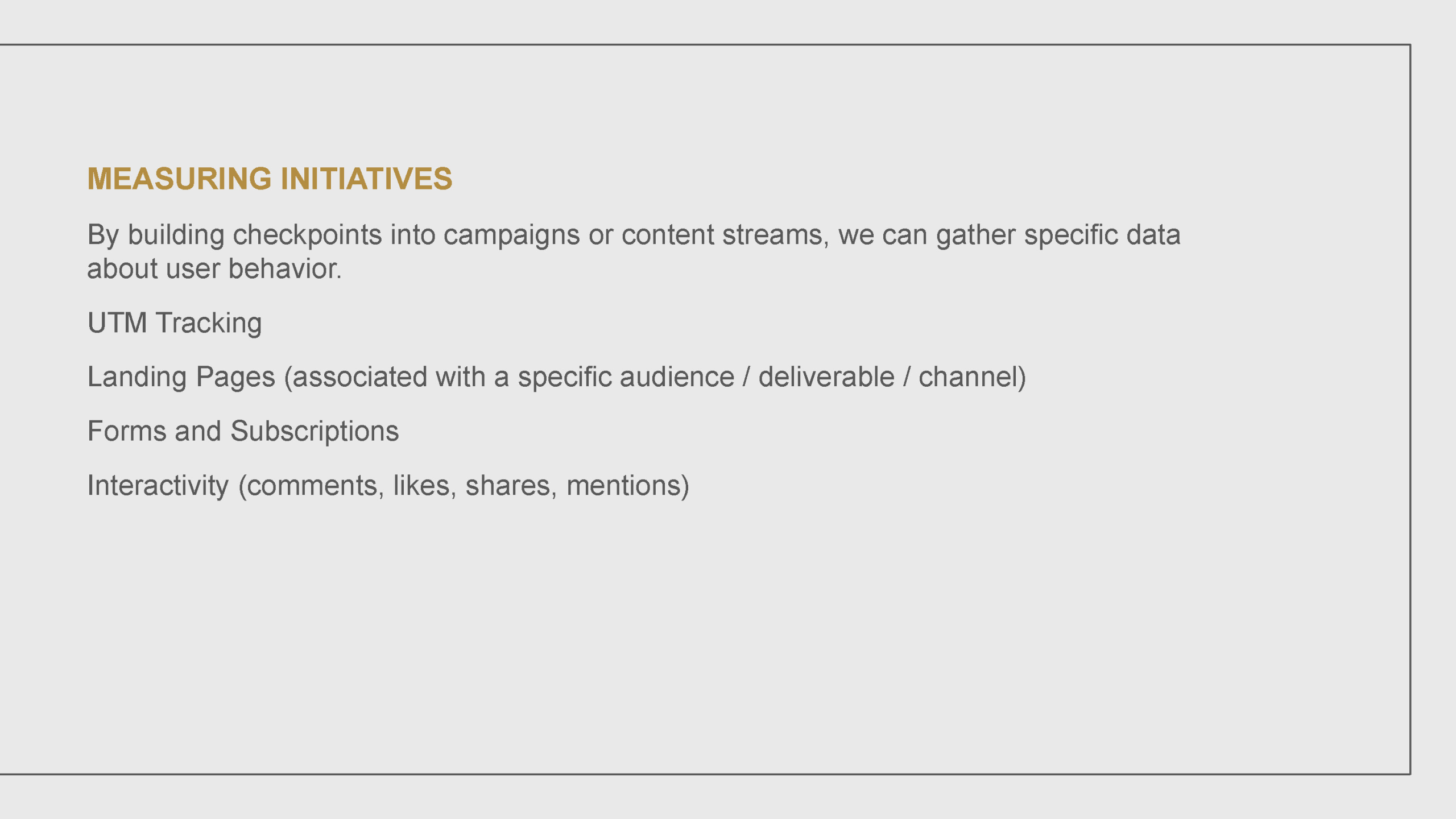
So, how DO we measure initiatives to see if they are really working?
While we will base content on our research, its relevance is still just a hypothesis. When content is produced, it should be done in a way that can be measured. Whether that means gateing the content – requiring an email submission – or tracking clicks or page views, there should be some checkpoint for content.
The value of gathering this data is to compare the success of different kinds of content. We can see what is attracting attention and look for patterns in popularity. What do our most visited pieces have in common?
Producing new content that aligns with the needs of our prospective and current families will strengthen our connection and align our internal practices with our position in the academic community.
In summary, we are showing up late to the conversation we’re hoping to influence. By offering content to our prospective families earlier in their journey to find a high school for their child, we will form connections that allow us to be more selective, yield the students we want, and provide us with data that can guide us into the future.
What do we need to do?
Figure Out Who We’re Talking To.
Collect data about our prospective families and develop personas to align our approach.
Build a Funnel.
Connect with our audience as early as possible by making a strong first impression, offering something of value, and creating more and more inroads. Communicate consistently throughout the family journey.
Measure and Refine.
Collect as much data as we can about engagement with our content. Apply that data to our communications and use it to continually refine our content, our brand, and our place in the market. Continue to research our prospective families and follow them forever.

Thank you for your time. I look forward to collaborating with you to extend our reach and build a strong institutional communications plan. I appreciate your partnership.