

Abstract
Generative Artificial Intelligence has brought something new into our culture: documents without origin, author, or aura. We are re-entering a cycle similar to that seen at the turn of the 20th century, but where authenticity itself has now become a design problem.
My project, Tomorrow and Tomorrow and the Next Day: Reconciling Quotidian Simulacra with the Need for Truth, explores what happens when AI starts producing content that feels human, but may not actually have a clear human author behind it. It explores — through research, conversation, and media analysis — the space between creation and interpretation to find new frameworks for learning, communication, and knowledge work that prioritize relationship-building, concession of absolutes, and a mindfulness of our connection to the natural world.
You remind me of a poem I can’t remember…
and a song that may have never existed…
and a place I’m not sure I’ve ever been to.
The Simpsons
Season 5, Episode 21
Methodology
This project references publications related to social and cultural theory, learning theory, and current practices surrounding generative artificial intelligence, as well as qualitative interviews and surveys with educators, school administrators, and creative professionals at the Lawrenceville School. Interview and survey material is used throughout the project to provide primary-source context to theoretical frameworks.
Introduction
Generative Artificial Intelligence has brought something new into our culture: documents without origin, author, or aura. We are re-entering a cycle similar to that seen in early modernity with mechanization, but where authenticity itself has now become a design problem. We are again seeing things, previously valued as deeply human and of high intellectual, cultural, and personal value, being produced with less human effort.
New Simulacra
In The Work of Art in the Age of Mechanical Reproduction (1935), Walter Benjamin addresses the concept of aura — the effect of the presence of an object on its observer. He describes the decay of aura, which occurs when reproduction allows the distance between the observer and the object to change. Essentially, when objects are not observed in their original context, their meaning changes. We attach different significance and different value to reproductions — most often a decreased value. The development of new technologies changes the approach to making objects — they are designed to be reproduced simply because it’s expected that they will be. (Benjamin, 1935/2021)
Furthermore, objects — designed to be reproduced — can be used to stand in for the absence of a true form. This betrayal of absence gives way to a destabilized system of establishing truth. If something can be represented by a language of symbols, but can not otherwise be perceived (is only perceived as the signs of itself, with no alternative), then it exists in a simulacrum — a representation (or copy) of an entity that has no original. (Baudrillard, 1981/1994)
An object created by artificial intelligence is something beyond reproduction and simulation — it is a recombination of symbols with no stable author or traceable origin. Because authenticity can be maintained only so far by the existence of an original object, when context and origin are undiscoverable, meaning must be constructed.
As we face the reality of these quotidian simulacra (everyday interaction with content of no clear origin), we need to develop a code for authenticity, a new means of interpreting authorship and assigning value. Our systems of understanding must evolve to process this new class of representation.
Unimaginable Quantities
Just as reproduction made it possible for objects to meet us in our situations (thereby changing their own context and meaning), generative AI repackages, recombines, and repositions information — but in exponentially larger quantities.
The availability and enormity of all the brilliance and beauty of humanity, ready to be compared, combined, and critiqued is overwhelming. Just as computer technology helps us to understand and work with unimaginable numbers, AI helps us understand and work with unimaginable history.
In a state of such an overabundance of information, value shifts from scarcity of content (original, authentic content) to systems of selection, framing, and interpretation. Value is found in connection and relationships that are made by human interaction and introspection.
On first consideration, this seems terribly positive. However, in qualitative interviews with educators, school administrators, and creative professionals, a general sense of anxiety came through in three primary ways:
Concerns surfaced regarding verification, academic legitimacy, and perceived correctness.
Generating content is a social practice. AI generated content was described as a violation of social contract and essentially an inconsiderate form of expression.
And, most notably, generative AI was described as a debaser of human identity and a detractor of value from human endeavor.
We don’t necessarily have to concede that there will be great loss in our new abundance of information. There are structures we can lean on to contain this uncertainty.
Learning Theories
In learning design, an element of Constructivist Learning Theory is that “the explanation of all phenomena, whether physical or social, is to be sought in one’s own mental development and nowhere else.” Basically, information — no matter its scale or quantity — does not become knowledge until it is contextualized by the intellectual development of the individual. “The cognitive organism is first and foremost an organizer who interprets experience and, by interpretation, shapes it into a structured world. That goes for experiencing what we call sensory objects and events, experiencing language and others; and it goes no less for experiencing oneself.” (Harasim, 2017, p. 83)
The availability of information in contemporary times is becoming less and less of a problem, especially with the advent of AI tools. This does not necessarily mean that we have this same abundance of knowledge. Bringing together the trajectories noted by Benjamin and Baudrillard with patterns of learning developed by constructivist theorists shows us a future where information may be more and more difficult to process into meaningful knowledge, due to the decay of origin, author, and aura. (Baudrillard, 1981/1994; Benjamin, 1935/2021; Harasim, 2017)
Collaborativism – inductive reasoning facilitated by an abundance of information — challenges this worry and complements constructivism when presented as discussion-based learning. While constructivism helps explain how individuals assign meaning and value and create knowledge out of information, collaborativism shows how that meaning and value is tested, revised, and socialized.
Together, constructivism and collaborativism acknowledge the learners’ ability to change their environment while responding to it. Communication is more than the transmission of information; it transforms meaning. (Schunk, 2011)
Codification
The social side of constructivism directly addresses the modern shift towards relational aesthetics in fine art: meaning is constructed through social experiences shared between author and viewer. In the absence of an author, the viewer is sharing an experience with a myth — a narrative, accepted as truth, which functions as a second-order system of codification.
From Roland Barthes: “If one wishes to connect a mythical schema to a general history, to explain how it corresponds to the interests of a definite society, in short, to pass from semiology to ideology, it is obviously at the level of the third type of focusing that one must place oneself: it is the reader of myths himself who must reveal their essential function.” (Barthes, 2013, p. 128)
If the author becomes a myth, then the viewer participates in revealing the function of the myth and, in turn, takes on the ability to function as its author. Generative AI tools — and the artifacts they produce — are not separate from systems of power or meaning-making, but are themselves codified with established cultural structures.
“The development of culture [is] the internalization of the tools of the culture…Tools emerge and change, as do cultures. Tools are part of our cultural and cognitive development.” (Harasim, 2017, p. 86)
Technochauvinism
In our current culture, technology and innovation most often refers to computers or software. Innovation of systems, of thinking, of social architecture, is so much more impactful — so much scarier — that we don’t like looking directly at it. We displace our assessment of these systems onto their products.
Rather than adapting to the advent of AI in schools by reconsidering the idea of institutional validation of knowledge, we simply seek to regulate the use of new tools. It may be that the tools themselves are only bringing to light the flaws of larger systems.
So far, AI tools have proven to highlight a number of negative systemic myths — racism, misogyny, ableism, prioritization of profit over ethics, etc. Nothing new, really. (Bates, 2025)
Bias, both of programmers and data inclusion, is written into predictive analysis, which is validated by technochauvinism — the belief that those involved in building and working with emerging technologies are seen as somehow more enlightened than others because they can access these means of production and shape their form and impact. Qualities associated with computers — like objectivity, unquestionable precision, the ability to process unimaginable numbers, and immediate recall with infinite memory — can be falsely ascribed to the makers of software, giving them mythic power and their output unduly high value.
Technology is optimized for people who are most similar to the people who build it — people who have existing access to technology, the privilege of education, and the means and ability to live in or move to centers of business innovation.
People in STEM fields are particularly less likely to have formal education in the social sciences and ethics that might guide their choices in developing new technologies. At the same time, technochauvinism encourages adoption of new technologies in educational settings — including assessment technology. (Broussard, 2023)
Skills and Assessment
Although it’s nearly impossible to create a completely objective assessment, when we introduce AI-based assessment, we run the risk of placing undue trust in flawed mathematical models.
A notable example is the International Baccalaureate’s use of predictive analysis (based on demographic information about students) to assign “probable” test scores to students during the pandemic. This model was grossly incorrect, as the data used for prediction showed historical correlation between geographic location and test scores, but did not assess the actual individuals’ proficiency. (Broussard, 2023)
Furthermore, as the nature of knowledge work evolves, the usefulness of skills that can be objectively assessed diminishes. Because the half-life of specialist knowledge is getting shorter and shorter as technology advances exponentially, we lose the ability to spend adequate time training to develop subject-matter mastery. Skills that are rising in value (pattern recognition, empathy, social aptitude, adaptability, perspective, etc.) are more abstract and can’t be measured as clearly.
Essentially, the most valuable skill workers can carry into the future is the ability to navigate environments that are in constant flux. Trying to quantify those skills with mathematical equations will not only be inaccurate but serve to produce new misleading information that will be ingested back into our systems.
Flattening and False Equivalencies
This ingestion and recombination of information has the power to perpetuate biases and marginalization through skewed data and limited access. Value and truth are, logically, associated with quantity — if a critical mass is in agreement, we see truth. If we continue to validate popular ideas without critique, we compound bias because we are cycling these ideas back through AI tools and multiplying their perceived value.
Published histories rarely reflect the perspective of marginalized populations and selectively include stories that make those in power heroes. When we begin interpolating or judging events by contemporary standards, we make it much harder on ourselves to retain empirical facts and much easier to retain sensational things and ideas that reinforce our current thinking.
“…computer scientists create such useful tech systems that their problematic ideas about society are overlooked. Race is a social construct but it is often embedded in computational systems as if it were scientific fact.” (Broussard, 2023, p. 30)
If human perception is unable to attain certain knowledge, we have to recognize that any statement of “truth” beyond that perception is an attempt to exert power and should be presented as preaching, not teaching. Myths centered on unknowable topics are not only a way to assuage fear, they are a part of a system of narrative communication designed to maintain and reinforce power structures.
As we relinquish authorship, we need to be cautious not to place undue value on content with concrete authors – we have to be able to create new value. Pieces that are unauthored need to be seen as a reflection of contemporary movement and not deprecated in favor of historically valued ideas and objects. Authorless narratives need to be tested in social settings as we can’t meaningfully codify information within the limits of individual identities.
Though this codification has the potential to do great harm, the experience of processing information through narrative is an essential part of creating knowledge.
Teaching and Learning
Western educational and narrative traditions often rely on dichotomy, conflict, and individual achievement, which can sit uneasily beside collaborative models of learning. This extends to learning through stories, a primary influence on development and socialization. Western storytelling very often centers around good vs. evil and exacting justice by force or punishment, which is an uncomfortable and aggressive concept in comparison to the environments we dedicate to learning. Learning to build and maintain a culture of empathy and connection requires lessons to be imparted in the context of the situations they apply to.
Lessons can come from modeling behavior and speaking about why teachers are doing things and what they value. Learners can be brought along with teachers’ reasoning and decision-making and corrected by narrative and example, rather than hurtful or restrictive punishment unrelated to the undesirable behavior. Naturally, personal stories and lived experiences are part of the lesson and austerity and infallibility are foregone in the interest of collaborative growth. (Merriam & Associates, 2007)
Managing a Reduction of Identity Markers
When synthesized narratives are delivered by an AI tool, we lose the identity markers of a speaker. This can affect understanding in two opposite ways: it can inhibit the development of empathy by homogenizing narrative voice; it can reduce prejudiced listening if the listener is accustomed to projecting their own identity onto the tool.
In the first case, if trusted information is consistently presented in a homogenized voice, it can foster a stronger sense of otherness when an unfamiliar voice is heard, thereby decreasing the perceived value of the information to the listener.
In the second case, existing bias on the part of the receiver can be mitigated by reducing or removing markers of otherness — language choices, terms with connotations, “correctness,” assumptions, etc. The biased listener has the opportunity to isolate concepts without the feeling of mistrust they have built in their reception of information.
In order to embrace the benefit of increased receptivity and reduce the homogeneity of published information, we can connect new information to social settings. When processing information that has fewer identity markers, it helps for those processing that information to have a strong sense of their own identity.
Helping students articulate their identity in different situations reinforces that while we have innate qualities and selves, our presence is a force among other presences and there are power dynamics surrounding that force that change with context. Without invalidating or judging individuals, it’s important to discuss how people perceive each other and how they can make space for each other.
When students are self aware, they are more likely to empathize with others. They can de-center themselves without feeling any sense of loss or erasure and approach others without fear or pretense. This self-assuredness allows students to approach each other with curiosity and generosity.
To build this self-awareness, teachers can employ discussion-based learning, verbal and physical storytelling, and intentionally designed spaces. With these methods, students build meaning together by applying principles of relational aesthetics as reflexive differentiation of their own identities. As they process information into narratives — and experience their colleagues’ reception and reaction to those narratives — they augment their own understanding of the source information and their identity in relation to it. When these interactions take place in spaces designed specifically to facilitate them, the experience of co-authorship and designed meaning is reinforced as something that occurs when in direct contact and communication with others. The place of the teacher, then, shifts from instruction to facilitation.
Teaching moments (opportunities for facilitation) are found anywhere that narratives are. Discussions about popular media, authored or not, and relating to the stories represented in media are opportunities to develop meaning in social groups.
I Am Not a Robot
Part of the development of AI tools is training them to seem human. Though they may not function as authors, they are imbued with communication patterns from human authors. In response to survey questions regarding authorship and authenticity, respondents expressed aversion (maybe even disgust) to the idea of synergistic use of AI tools:
“Every good or terrible human-made art and writing matters infinitely more… than anything made or ‘edited’ by an AI.”
“Personally, I think AI generated content with no clear authorship or pedigree has no value.”
“In essence, AI is turning users into bots.”
Rather than viewing AI as a means of augmenting human production, it seems to be viewed as something entirely other than humanity. As such, humans will need to design new markers of humanity into real life as a signal and differentiator to indicate human authorship. Regardless of the degree to which an artifact is produced from human origins, people naturally have a desire to draw a boundary between what is and what isn’t human. However, in reasserting our humanity by engaging in behaviors that are “other” to AI tools, we are in large part allowing those same tools to determine our new markers of humanity.
To balance this allowance, we can take steps to make sure that human-authored histories and lived experiences are recoverable (in different formats and non-degradeable or appropriately degradable). Though we will always need artifacts, we can safeguard what we see as products of exclusive humanity by producing artifacts in non-digital media and by being open to co-authorship by socializing narratives and stories for re-codification.
Framework for Constructing Authenticity without the Presence of an Author
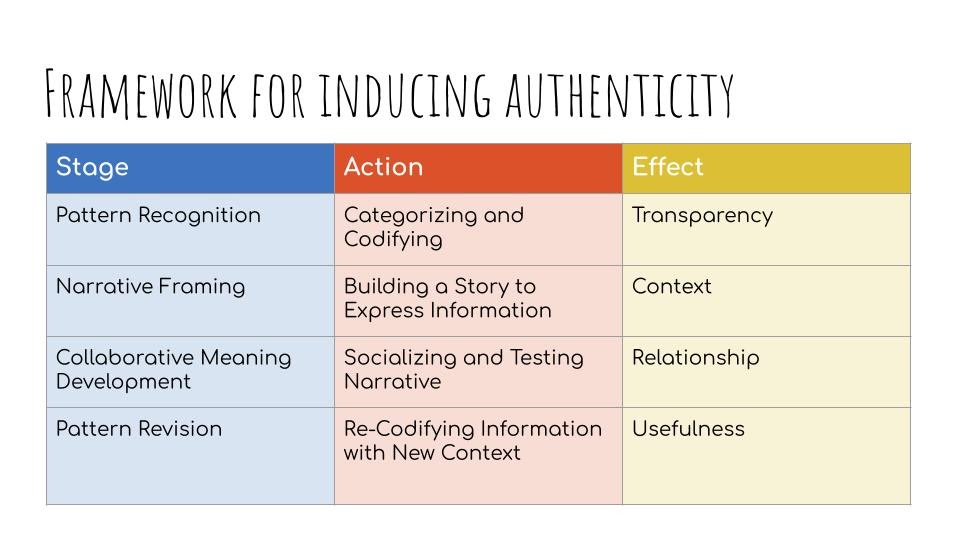
In addition to these reflective and contextual connections, we can establish a cyclical model for interpreting information when origin, author, and context are unclear. The framework has four stages: pattern recognition, narrative framing, collaborative meaning development, and pattern revision. Instead of seeking validation from the origin of an artifact, learners can process information regardless of its perceived value or authenticity. Leaving behind the identity of the artifact, learners examine the signals they recognize, identify narratives that shape interpretation, test meaning through social exchange, and revise their understanding for future encounters.
Artificial Intelligence does not destroy authenticity — it reminds us that authenticity has always been negotiated by social agreement. In a world of quotidian simulacra, the task is not to identify what is “real,” but to design better systems for constructing meaning.
References
Barthes, R. (2013). Mythologies (A. Lavers, Trans.). Hill and Wang. (Original work published 1957)
Bates, L. (2025). The new age of sexism: How AI and emerging technologies are reinventing misogyny. Sourcebooks.
Baudrillard, J. (1994). Simulacra and simulation (S. F. Glaser, Trans.). University of Michigan Press. (Original work published 1981)
Benjamin, W. (2021). The work of art in the age of mechanical reproduction. Lulu Press. (Original work published 1935)
Broussard, M. (2023). More than a glitch: Confronting race, gender, and ability bias in tech. The MIT Press.
Harasim, L. (2017). Learning theory and online technologies (2nd ed.). Routledge.
Merriam, S. B., & Associates. (Eds.). (2007). Non-western perspectives on learning and knowing. Krieger Publishing Company.
Schunk, D. H. (2011). Learning theories: An educational perspective (6th ed.). Pearson.
Here is the text – include assignment